Introduction
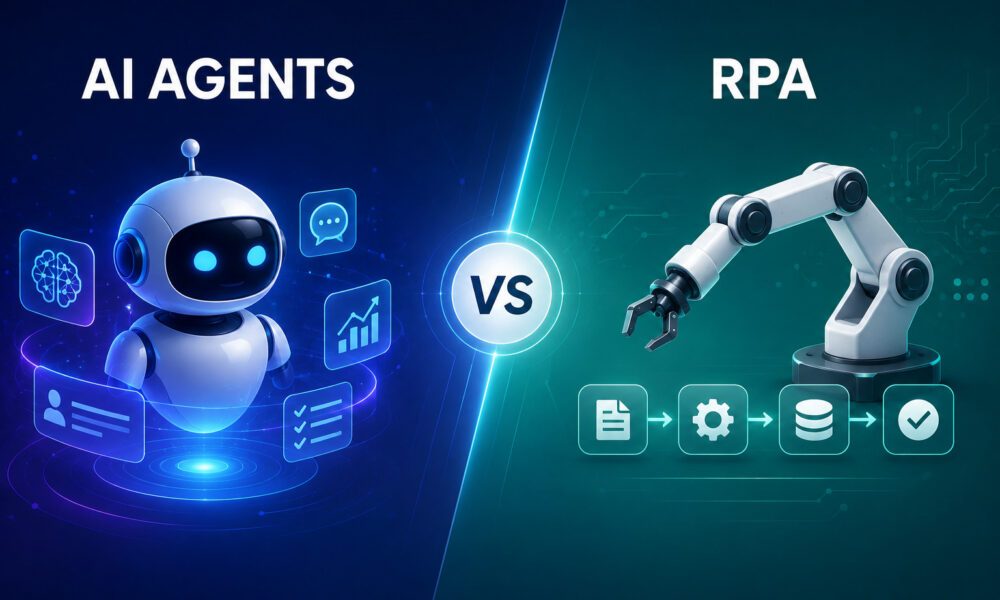
Automation in large enterprises is now split between two approaches. One group focuses on RPA, built over years with established bots, teams, and processes. Another group is focused on AI agents, presenting them as a more flexible and advanced solution.
Both viewpoints have merit but treating them as competing technologies often leads to poor decisions. Some teams rely too heavily on RPA tasks it cannot handle, while others attempt to replace stable automation with AI systems that are not fully ready for certain workloads. AI agents and RPA serve different purposes. Understanding where each fit, and how they can work together, is one of the most important decisions for operations leaders in 2026.
What RPA Is Designed For
Rule-Based Automation
Robotic Process Automation works by mimicking human actions on a computer interface. It follows predefined steps such as clicking, entering data, or navigating systems.
RPA is highly effective for structured, repetitive workflows. These include tasks like invoice processing, data entry, report creation, and compliance documentation.
Key Strengths of RPA
- Consistent execution with predefined rules
- High accuracy for repetitive tasks
- Full auditability of actions
- Lower operational cost compared to manual work
The RPA market continues to grow, showing that it remains a core part of enterprise automation.
Ideal Use Cases
RPA works best in environments where:
- Data is structured and predictable
- Processes follow clear rules
- Applications change infrequently
- Transaction volumes are high
Examples include accounts payable, HR data updates, system reconciliations, and regulatory reporting.
Where RPA Falls Short
1. Fragility of UI-Based Automation
RPA depends on user interface elements. When applications change, bots can break. Even minor updates can cause failures, requiring manual fixes and ongoing maintenance. As the number of bots increases, maintenance becomes a major effort.
2. Limited Handling of Unstructured Data
RPA cannot interpret unstructured data like emails, documents, or free text. If inputs do not match expected formats, the process stops. This limits RPA’s ability to handle complex or variable workflows.
3. High Dependency on Human Intervention
RPA workflows include exception paths. When unexpected cases appear, the bot escalates to a human. If exception rates are high, the gains from automation can reduce significantly.
What AI Agents Are Designed For
1. Goal-Oriented Automation
AI agents take a different approach. Instead of following fixed steps, they receive a goal and determine how to achieve it. They can interpret inputs, break tasks into steps, and adjust actions based on new information.
2. Core Capabilities
AI agents bring three major capabilities:
- Ability to work with unstructured data
- Dynamic planning of tasks
- Adaptation to changes in real time
They can process emails, analyze documents, and handle workflows where steps are not fixed.
3. Cross-System Interaction
AI agents can work across multiple systems without rigid scripting. They understand application context and adjust actions even if interfaces change. This makes them more flexible than traditional automation tools.
AI Agents vs RPA: Decision Framework
The key question is not which is better, but which is suitable for a specific process.
When to Use RPA
RPA is the right choice when:
- Processes are rule-based and predictable
- Data is structured
- Systems are stable
- High transaction volume exists
- Strong audit trails are required
RPA provides reliable and consistent outcomes in these cases.
When to Use AI Agents
AI agents are better suited when:
- Inputs are unstructured
- Decision-making is required
- Exception rates are high
- Systems change frequently
- Workflow steps vary
They are useful for tasks that require interpretation and flexibility.
The Combined Approach
Why Enterprises Use Both
Many organizations are moving toward a combined model.
RPA handles structured execution, while AI agents manage reasoning and adaptation. This approach allows automation of more complex processes.
How the Hybrid Model Works
In a combined setup:
- AI agents interpret input and decide actions
- RPA bots perform repetitive system tasks
- Systems work together to complete workflows
For example, an AI agent can process a customer request and trigger an RPA bot to update records in a legacy system.
Benefits of the Combined Approach
- Broader automation coverage
- Reduced manual intervention
- Improved handling of complex workflows
- Better scalability
Vendor Direction
Major automation platforms are already moving toward integration.
- UiPath combines AI and automation tools
- Automation Anywhere is expanding AI capabilities
- Microsoft Power Automate integrates with AI-driven assistants
- ServiceNow uses AI to manage workflows and automate processes
The trend shows that automation platforms are combining reasoning and execution into unified systems.
Governance Considerations
Both RPA and AI agents require strong governance.
RPA Governance
- Managing large numbers of bots
- Maintaining documentation
- Ensuring compliance and audit trails
AI Agent Governance
- Defining decision boundaries
- Tracking how decisions are made
- Managing errors and accountability
Organizations need clear frameworks to manage both technologies safely and effectively.
Practical Decision Guide
Before choosing a solution, consider these questions:
- Can the process be fully defined in advance?
- How often do systems change?
- What is the exception rate?
- What level of audit and control is required?
The answers help determine whether RPA, AI agents, or a combination of both is the best fit.
Conclusion
The idea that AI agents will replace RPA is misleading. Both technologies solve different problems. RPA remains a strong solution for structured, high-volume processes. AI agents address tasks that require flexibility and reasoning.
The most effective approach in 2026 is to combine both. This allows organizations to automate more processes while maintaining reliability and control. A clear understanding of each technology’s strengths and limitations is key. Organizations that apply the right tool to the right task will build more effective and scalable automation systems.
FAQs
1. What is the main difference between AI agents and RPA?
RPA follows predefined rules and handles structured tasks, while AI agents can interpret inputs, make decisions, and adapt to changing situations. AI agents focus on flexibility, whereas RPA provides consistent and predictable execution.
2. Can AI agents replace RPA completely?
No. AI agents cannot fully replace RPA. RPA is still better for repetitive, rule-based processes. Most organizations use both together, combining RPA for execution and AI agents for decision-making in complex workflows.
3. When should a business choose RPA over AI agents?
RPA is ideal when tasks are repetitive, data is structured, and processes are stable. It is also preferred in regulated environments where consistency, accuracy, and clear audit trails are critical for compliance.
4. What types of tasks are better for AI agents?
AI agents are better for tasks involving unstructured data, frequent exceptions, or decision-making. Examples include handling customer emails, processing documents, and managing workflows that require interpretation or dynamic planning.
5. What are the risks of using AI agents?
AI agents can make incorrect decisions if not properly monitored. Challenges include lack of transparency in decision-making and difficulty in auditing actions. Proper governance and controls are required to manage these risks effectively.
6. Why are companies combining AI agents and RPA?
Combining both allows businesses to automate end-to-end processes. AI agents handle reasoning and variability, while RPA manages repetitive tasks. This approach increases efficiency and expands automation coverage across operations.
7. How should enterprises start adopting AI agents?
Enterprises should begin with processes that involve unstructured data or high exception rates. Starting small, testing performance, and integrating with existing RPA systems helps organizations adopt AI agents without disrupting existing workflows.