
The month-end close remains one of the busiest periods for finance teams. Accountants spend days gathering data, reconciling accounts, reviewing transactions, and preparing reports that reflect the company’s financial position. Much of this work still depends on spreadsheets, emails, and manual checks, making the process time-consuming and prone to errors.
Meeting reporting deadlines can become difficult when data comes from multiple systems and departments. Even minor discrepancies may require additional reviews, delaying the close cycle.
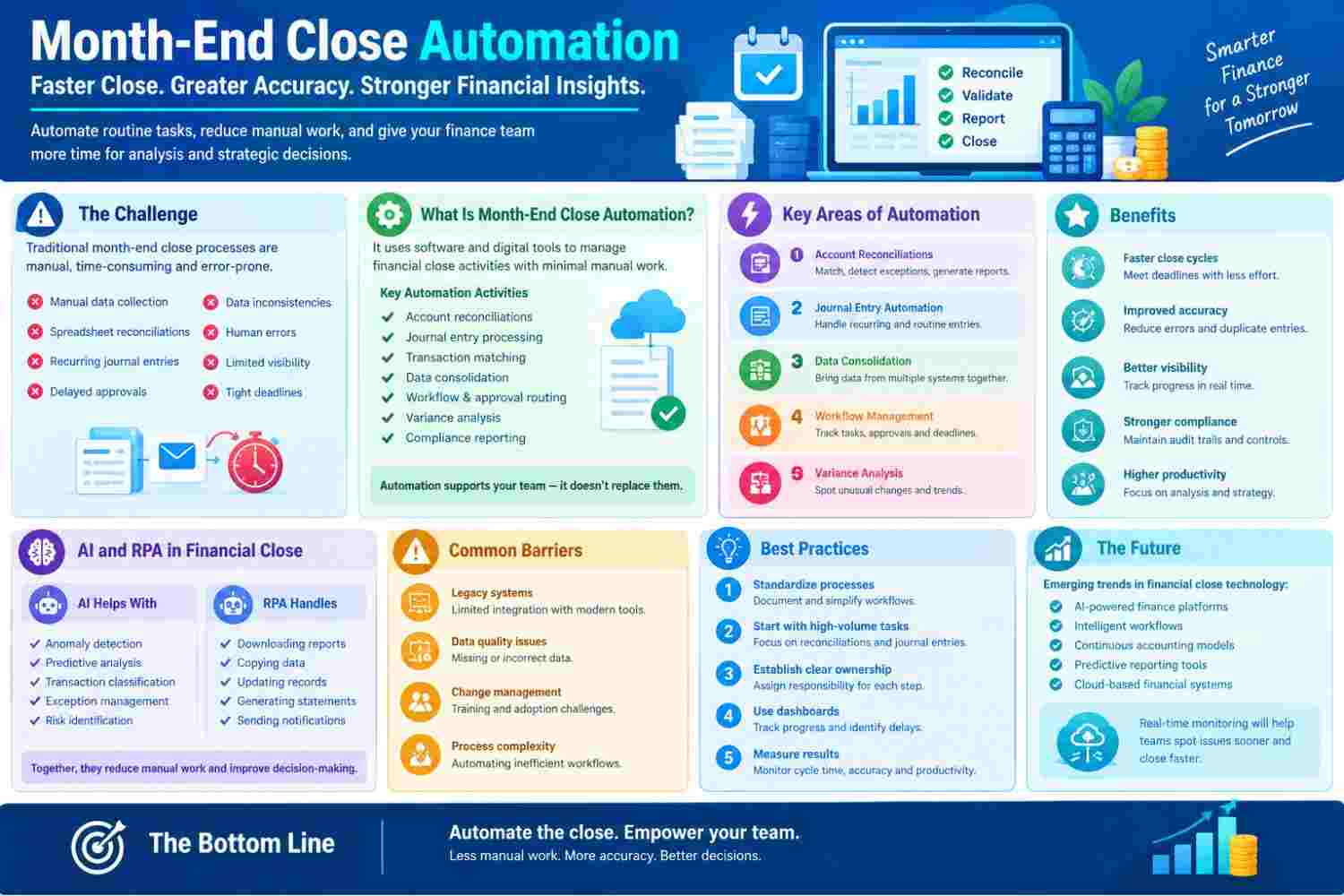
Many companies are addressing these challenges through month-end close automation finance solutions. With the support of financial close technology, finance teams can automate routine tasks, improve data accuracy, and produce reports faster while spending more time on analysis and decision-making.
Why the Traditional Month-End Close Process Creates Challenges
The month-end close requires finance teams to collect data from multiple sources, reconcile accounts, review transactions, and prepare reports for stakeholders. In many organizations, these activities still rely heavily on manual processes.
Common challenges include:
- Manual data collection
- Spreadsheet-based reconciliations
- Recurring journal entries
- Delayed approvals
- Data inconsistencies
- Human errors
- Limited visibility into task progress
- Tight reporting deadlines
Finance professionals often spend considerable time gathering missing information and correcting discrepancies. When issues are identified late in the process, additional reviews may be required, increasing workloads, and extending the close cycle.
What Is Month-End Close Automation?
Month end close automation finance refers to the use of software and digital tools to manage financial close activities with less dependence on manual processes. Rather than relying heavily on spreadsheets, emails, and repeated data entry, finance teams use connected systems that collect, reconcile, and report financial information automatically.
Automation can support tasks such as:
- Account reconciliations
- Journal entry processing
- Transaction matching
- Financial data consolidation
- Workflow management
- Approval routing
- Variance analysis
- Compliance reporting
The purpose of automation is not to replace finance professionals. It helps reduce time spent on routine tasks, allowing teams to focus on reviewing financial performance, investigating exceptions, and supporting business decisions with accurate and timely information.
The Growing Role of Financial Close Technology
Modern financial close technology gives finance teams a centralized environment for managing close activities. Instead of working across multiple spreadsheets and disconnected systems, teams can access financial data, workflows, and reporting tasks from a single platform.
These solutions often connect with:
- ERP systems
- Accounting software
- Banking platforms
- Payroll applications
- Expense management tools
- Procurement systems
Data moves automatically between connected applications, reducing the need for manual transfers and duplicate entries.
Finance leaders can monitor:
- Close task status
- Outstanding reconciliations
- Approval bottlenecks
- Compliance requirements
- Reporting readiness
With greater visibility into ongoing activities, teams can identify issues earlier, address delays quickly, and maintain better control over the month-end close process.
Key Areas Where Finance Teams Are Applying Automation
1. Account Reconciliations
Account reconciliation is one of the most time-consuming parts of the month-end close. Finance teams must compare internal records with bank statements, customer accounts, vendor accounts, and other financial data sources.
Automation can help:
- Match transactions automatically
- Identify exceptions
- Highlight discrepancies
- Generate reconciliation reports
This allows finance professionals to focus on unresolved items instead of reviewing every transaction manually.
2. Journal Entry Automation
Recurring journal entries are a routine part of the close process. Common examples include:
- Depreciation expenses
- Accruals
- Amortization entries
- Payroll adjustments
Automation tools can create and post these entries based on predefined rules, reducing manual input and improving consistency across reporting periods.
3. Financial Data Consolidation
Organizations operating across multiple business units often need to combine data from different systems and entities. Financial close technology helps collect and consolidate information into a single reporting environment.
Benefits include:
- Reduced duplicate entries
- Consistent reporting practices
- Faster report preparation
4. Workflow Management
Close activities involve multiple stakeholders, making task coordination essential. Automation software can:
- Assign tasks
- Send reminders
- Track deadlines
- Record approvals
This provides greater visibility into responsibilities and reporting progress.
5. Variance Analysis
Finance teams regularly compare results against budgets, forecasts, and prior periods. Automated analytics tools can highlight unusual variances and account movements, helping teams investigate potential issues more quickly.
Benefits of Month-End Close Automation
1. Faster Close Cycles
A major advantage of automation is the reduction in closing time. Tasks such as data collection, reconciliations, and approvals can be completed more quickly, helping finance teams meet reporting deadlines and access financial information sooner.
2. Improved Accuracy
Manual processes often lead to issues such as:
- Duplicate entries
- Formula errors
- Incorrect account coding
- Missing transactions
Automation reduces repetitive data entry and applies validation checks, helping finance teams maintain more accurate financial records.
3. Better Visibility
Modern platforms provide dashboards that display:
- Open tasks
- Completed activities
- Pending approvals
- Outstanding reconciliations
This gives finance leaders a clearer view of close progress and helps identify delays before reporting deadlines are affected.
4. Stronger Compliance
Automated systems maintain detailed records of user activities, approvals, process steps, and data changes. These audit trails make it easier to support internal reviews and regulatory requirements.
5. Higher Employee Productivity
Many routine tasks can be handled through automation, allowing finance professionals to spend more time on:
- Financial planning
- Business analysis
- Risk assessment
- Performance reviews
How Artificial Intelligence Is Supporting Financial Close Operations
AI-powered tools can review large volumes of financial data, identify patterns, and highlight transactions that may require further review.
Common applications include:
- Anomaly detection
- Predictive analysis
- Transaction classification
- Exception management
- Risk identification
For example, AI can flag unusual transactions based on past activity and account behavior. Instead of reviewing every record manually, finance teams can focus on exceptions that need attention.
AI can also help identify reporting inconsistencies, recurring errors, and unusual account movements. As more financial data is processed, these systems become better at recognizing patterns and supporting faster reviews. This gives finance professionals additional insights while reducing the time spent on routine checks.
Robotic Process Automation in Finance
Robotic Process Automation (RPA) uses software bots to handle repetitive, rules-based tasks across finance operations. Many organizations use RPA to reduce the manual effort involved in routine activities that occur during the month-end close process.
Common applications include:
- Downloading reports
- Copying data between systems
- Updating records
- Generating statements
- Sending notifications
Although these tasks are relatively simple, they can consume valuable time when performed repeatedly across departments. RPA helps finance teams complete them more quickly and with greater consistency.
By handling routine administrative work, software bots allow finance professionals to spend more time reviewing financial results, investigating exceptions, and supporting business decisions with relevant insights.
Common Barriers to Automation Adoption
While automation offers clear benefits, implementation is not always straightforward. Finance teams often encounter challenges related to systems, data, and processes.
1. Legacy Systems
Older financial applications may not integrate easily with newer automation tools, creating additional work during implementation.
2. Data Quality Issues
Automation relies on accurate and consistent data. Missing records, duplicate entries, or incorrect information can affect results and require corrective action.
3. Change Management
Employees may be hesitant to adopt new tools. Organizations often support adoption through:
- Training programs
- Clear communication
- Leadership support
4. Process Complexity
Automating inefficient workflows can create additional challenges. Many organizations review and simplify existing processes before introducing automation to improve outcomes.
Best Practices for Successful Month-End Close Automation
Companies planning automation projects often begin by reviewing existing processes and identifying areas that consume the most time during the close cycle.
1. Standardize Processes
Documenting workflows and creating consistent procedures can help reduce confusion and support smoother automation efforts.
2. Start with High-Volume Tasks
Many organizations begin with activities such as:
- Account reconciliations
- Recurring journal entries
- Data consolidation
Automating these tasks often delivers noticeable results early in the project.
3. Establish Clear Ownership
Each automated process should have a designated owner responsible for monitoring performance, resolving issues, and maintaining accountability.
4. Use Dashboards
Real-time dashboards help teams track task status, approvals, and outstanding activities throughout the close process.
5. Measure Results
Finance leaders commonly track:
- Days to close
- Reconciliation completion rates
- Error rates
- Productivity gains
Regular reviews help identify areas for improvement and support long-term automation goals.
The Future of Financial Close Technology
New capabilities are making it easier to monitor financial data throughout the month rather than waiting until the closing period.
Key areas attracting attention include:
- AI-powered finance platforms
- Intelligent workflows
- Continuous accounting models
- Predictive reporting tools
- Cloud-based financial systems
Many organizations are adopting real-time monitoring to spot discrepancies and reporting issues sooner. This allows finance teams to address concerns before they affect the close process.
As these technologies become more common, finance professionals can spend less time collecting information and more time analyzing performance, assessing risks, and supporting business planning with timely financial insights.
Conclusion
The month-end close remains a core responsibility for finance teams, but manual processes can make reporting slower and more difficult to manage. Spreadsheets, repeated data entry, and fragmented workflows often add unnecessary pressure during the closing cycle.
For many organizations, month end close automation finance solutions are helping reduce routine workloads and improve reporting accuracy. Automation can support key activities such as account reconciliations, journal entries, workflow tracking, and variance analysis, allowing teams to focus on more valuable financial tasks.
At the same time, financial close technology is giving finance leaders better visibility into close activities and reporting progress. With the right tools and processes, organizations can produce financial reports faster while maintaining control, accuracy, and compliance.
FAQs
1. What is month-end close automation in finance?
Month-end close automation uses software to handle tasks such as reconciliations, journal entries, approvals, and reporting activities. It reduces manual work, shortens close cycles, and helps finance teams maintain accurate financial records.
2. How does financial close technology improve reporting accuracy?
Financial close technology improves reporting accuracy by validating financial data, identifying discrepancies, tracking approvals, and reducing manual data entry. These capabilities help finance teams produce more reliable and consistent reports.
3. What are the biggest benefits of automating the month-end close process?
Automating the month-end close can reduce reporting timelines, improve data accuracy, increase visibility into close activities, support compliance efforts, and allow finance professionals to spend more time on analysis.
4. Can small and mid-sized businesses benefit from close automation?
Yes. Small and mid-sized businesses can automate repetitive finance tasks, reduce spreadsheet dependency, improve reporting efficiency, and manage growing transaction volumes without expanding finance teams at the same pace.
5. How does AI support the financial close process?
AI supports the financial close process by detecting unusual transactions, identifying patterns in financial data, classifying transactions, and helping finance teams focus on exceptions that require review or investigation.
6. What processes are commonly automated during month-end close?
Organizations commonly automate account reconciliations, recurring journal entries, transaction matching, workflow approvals, data consolidation, reporting preparation, and compliance-related documentation to reduce manual effort and delays.
7. What should organizations consider before implementing automation?
Before implementing automation, organizations should assess process efficiency, data quality, integration requirements, employee training needs, and governance controls to avoid implementation challenges and improve long-term adoption outcomes.