Introduction
Human decision-making rarely depends on a single signal. A supervisor watching a production line listen for unusual sounds. A doctor studies a scan alongside patient history. A support agent evaluates both what a customer says and how they say it. Enterprise systems are moving in the same direction. Multimodal AI allows technology to combine multiple data inputs and interpret them together, creating a more complete understanding of real-world situations.
This shift is changing how applications are designed, deployed, and used across industries. By 2026, a significant share of enterprise AI applications relies on multiple data inputs rather than a single source. This change reflects a broader shift from isolated data analysis toward integrated intelligence across workflows.
What Is Multimodal AI?
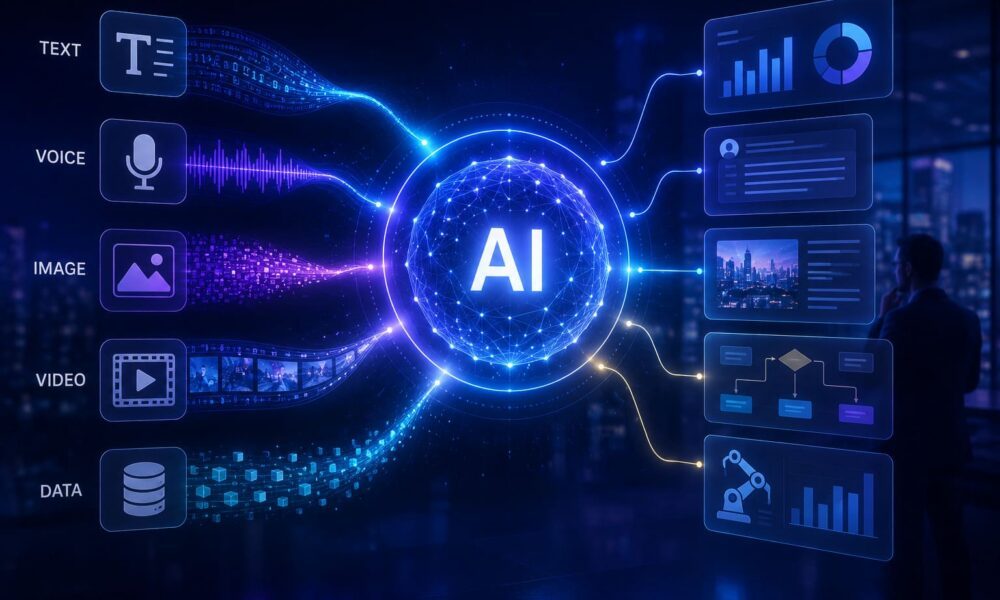
Multimodal AI refers to systems that process, interpret, and generate outputs using multiple data types such as text, images, audio, video, and sensor data within the same model or workflow.
Core Capabilities
- Cross-Modal Understanding
These systems do not treat inputs independently. They understand relationships between data types, such as how an image supports a written report or how an audio tone adds meaning to spoken words. - Context Integration
By combining inputs, multimodal AI creates a richer context that improves accuracy and relevance in outputs. - Multi-Output Generation
Systems can produce responses across formats, including text explanations, visual highlights, or audio feedback depending on the use case.
Why Single-Modality AI Reached Its Limit
Single-modality AI systems helped automate structured tasks, but they struggle with complex decision making.
Key Gaps in Traditional Systems
- Fragmented Insights
Each system processes only one type of data, leaving gaps that require human interpretation. - Higher Error Rates
Decisions made with partial information increase the risk of incorrect outcomes. - Operational Inefficiency
Teams must rely on multiple tools and manual processes to connect insights and slow workflows. - The Multimodal Advantage
Multimodal AI eliminates these gaps by bringing all relevant inputs into a shared context. This allows systems to interpret situations more accurately and support decisions that depend on multiple factors.
Enterprise Adoption Trends
1. Rapid Expansion Across Use Cases
Organizations are adopting multimodal AI across operations, customer engagement, and compliance tasks.
Key Drivers
- Growth of unstructured data
- Increased demand for real-time insights
- Pressure to improve decision accuracy
- Need to reduce operational delays
2. From Experimentation to Production
Many enterprises have moved beyond pilot projects. Multimodal systems are now part of production workflows, particularly in industries where decisions depend on multiple data sources.
Where Multimodal AI Is Delivering Value
1. Manufacturing: Connecting Signals Across the Factory
Manufacturing environments produce large volumes of data from machines, sensors, and inspection systems. Traditionally, these inputs were analyzed separately.
Quality Control
Multimodal systems combine:
- Visual inspection from cameras
- Acoustic monitoring of machinery
- Sensor data such as temperature and vibration
This combined analysis helps detect defects earlier and identify root causes more accurately.
Predictive Maintenance
By linking sound patterns with operational data and visual indicators, systems can predict equipment failures before they occur.
Worker Safety
Multimodal monitoring includes:
- Wearable sensor data
- Video feeds
- Environmental audio
These signals help identify risks such as fatigue, unsafe movement, or restricted area access.
2. Healthcare: From Data Silos to Unified Insight
Healthcare systems generate highly diverse data that often remains disconnected.
Clinical Decision Support
Multimodal AI integrates:
- Medical imaging
- Patient records
- Clinical notes
- Genetic data
This integration helps clinicians identify patterns that might not be visible when data is reviewed separately.
Diagnostic Accuracy
Combining multiple data types improves the ability to detect anomalies and reduces the likelihood of missed diagnoses.
Administrative Workflows
Document processing systems can interpret both content and structure, including forms, reports, and images. This reduces manual effort and improves efficiency in administrative tasks.
3. Customer Service: Improving Interaction Quality
Customer interactions increasingly involve multiple formats, including text, voice, and images.
Multichannel Understanding
Multimodal AI processes:
- Chat messages
- Voice conversations
- Screenshots and product images
Operational Impact
- Faster resolution of customer issues
- Reduced need for escalations
- More accurate responses
Agent Support
Human agents benefit from systems that provide a complete view of customer interaction, including history, sentiment, and supporting visuals.
4. Financial Services: Detecting Risk Across Signals
Fraud and compliance require analysis of both structured and unstructured data.
Fraud Detection
Multimodal systems combine:
- Transaction data
- Behavioral patterns
- Voice recognition signals
- Device and session data
This layered approach helps identify suspicious activity that would not be detected through a single signal.
Compliance and Documentation
Financial and legal documents often include text, tables, and visual markers. Multimodal AI interprets all elements together, improving consistency in compliance checks.
5. Retail and E-commerce: Enhancing Customer Experience
Multimodal AI is also reshaping retail operations.
Product Discovery
Customers can search using images, voice queries, or text descriptions. Systems interpret these inputs to deliver more relevant results.
Personalization
Combining browsing behavior, purchase history, and interaction data allows platforms to provide tailored recommendations.
Inventory and Store Operations
Cameras, sensors, and transaction data help monitor stock levels, detect anomalies, and optimize store layouts.
Implementation Challenges
1. Infrastructure Demands
- Compute Requirements
Processing multiple data streams requires higher computational power, particularly for real-time applications such as video analysis or voice processing. - Storage and Processing
Managing large volumes of diverse data types adds complexity to storage and retrieval systems.
2. Data Integration Complexity
- Format Alignment
Text, audio, and visual data must be standardized and synchronized. - Data Quality
Poor quality in any input stream can reduce overall system performance. - Legacy Systems
Older systems may not support integration with modern AI pipelines, requiring additional investment.
3. Governance and Risk Management
- Regulatory Differences
Different data types are subject to different legal and compliance requirements. - Privacy Concerns
Biometric and personal data must be handled with strict controls. - Model Accountability
Organizations must establish processes for validation, monitoring, and auditing of AI systems.
Design Considerations for Enterprise Leaders
Building the Right Data Foundation
Organizations need to focus on:
- Data availability
- Data consistency
- Integration frameworks
A strong data foundation is critical for multimodal AI to perform effectively.
Selecting the Right Use Cases
Not all processes benefit equally from multimodal AI. High-impact use cases usually involve:
- Multiple data inputs
- Time-sensitive decision making
- High cost of errors
Scaling Beyond Pilots
Successful deployment requires:
- Clear objectives
- Measurable outcomes
- Integration with existing systems
What the Future Holds
1. Domain-Specific Models
Organizations are moving toward models trained on specialized datasets. These models perform better in areas such as healthcare diagnostics or financial analysis.
2. Convergence with Action Systems
From Insight to Action
Multimodal AI is being combined with systems that can execute tasks, such as updating records or triggering workflows.
Real-Time Intelligent Systems
Future systems will process inputs continuously, allowing them to respond instantly to changing conditions in environments such as factories or customer support centers.
Conclusion
Multimodal AI represents a shift in how enterprise systems understand and respond to data. By combining multiple inputs, these systems provide a more complete view of operations and improve decision making across functions.
The value lies not just in accessing more data, but in connecting it meaningfully. Organizations that invest in strong data foundations, infrastructure, and governance will be better positioned to benefit from this shift. As adoption continues to grow, multimodal AI is expected to become a standard capability in enterprise applications, shaping how businesses operate and compete.
FAQs
1. What is multimodal AI in simple terms?
Multimodal AI refers to artificial intelligence systems that process and understand multiple types of data such as text, images, audio, and video together, allowing them to interpret situations more accurately compared to single-input AI systems.
2. Why is multimodal AI important for enterprises today?
Enterprises deal with diverse data sources daily. Multimodal AI helps combine these inputs into a unified view, improving decision making, reducing errors, and enabling systems to respond more effectively to real-world business scenarios.
3. How does multimodal AI improve customer service operations?
It allows systems to analyze customer messages, voice tone, and shared images at the same time, giving a complete picture of the issue and helping resolve problems faster with fewer escalations or repeated interactions.
4. What industries benefit most from multimodal AI adoption?
Industries such as healthcare, manufacturing, financial services, and customer support see significant benefits because they rely heavily on multiple data types that must be interpreted together for accurate insights and decision making.
5. What are the main challenges of implementing multimodal AI?
Challenges include higher computational demands, integrating diverse data sources, managing data quality, and addressing governance requirements across different data types such as audio, visual, and sensitive personal information.
6. How does multimodal AI differ from traditional AI systems?
Traditional AI systems usually focus on one data type, such as text or images, while multimodal AI combines multiple data types, allowing it to understand context more deeply and produce more accurate and relevant outputs.
7. What is the future of multimodal AI in enterprise applications?
Multimodal AI is expected to become a core component of enterprise systems, evolving with domain-specific models and integration with action-based systems, enabling applications that can interpret complex inputs and perform tasks with minimal human intervention.