
Artificial intelligence is no longer limited to pilot programs or experimental projects. Across industries, enterprises are integrating AI into core business operations to improve productivity, support decision-making, reduce costs, and create new growth opportunities.
One question continues to dominate leadership discussions: what is the actual value generated from AI investments? In 2026, executives want clear evidence that AI initiatives are contributing to business performance. This has made AI ROI enterprise measurement a growing priority for organizations of all sizes.
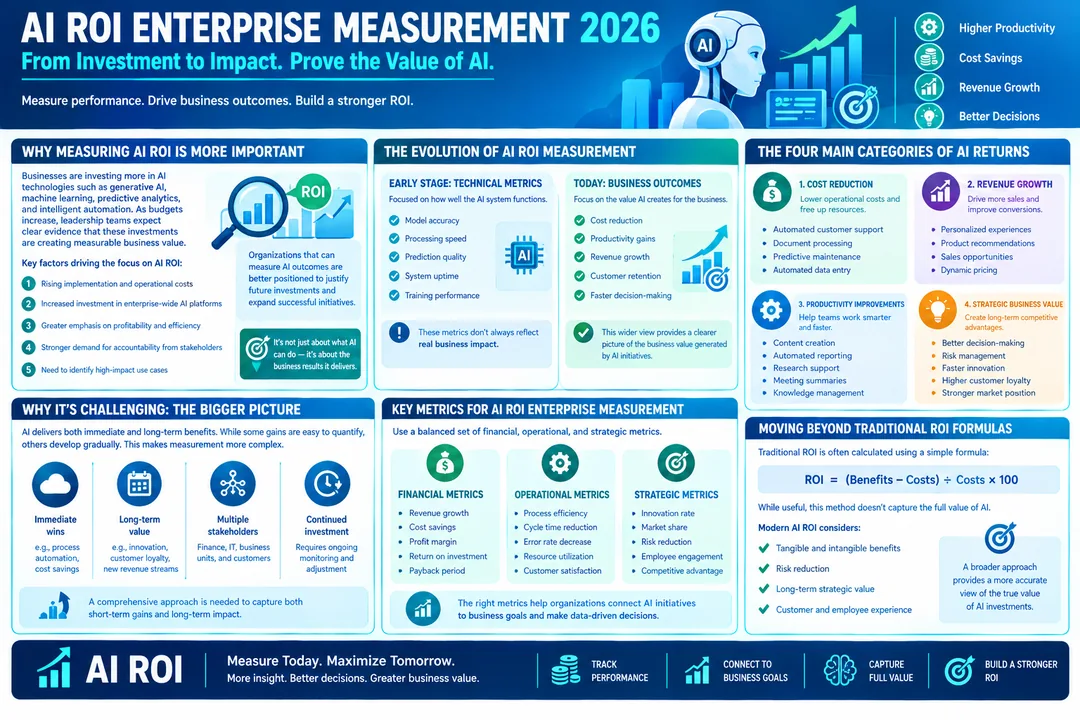
The challenge is that AI delivers both immediate and long-term benefits. While some gains are easy to quantify, others develop gradually. As a result, leaders are adopting broader approaches to evaluate the return on AI investment 2026 and connect AI efforts to measurable business outcomes.
Why Measuring AI ROI Is More Important
Businesses are investing more in AI technologies such as generative AI, machine learning, predictive analytics, and intelligent automation. As budgets increase, leadership teams expect clear evidence that these investments are creating measurable business value.
Several factors are driving the focus on AI ROI enterprise measurement:
- Rising implementation and operational costs
- Increased investment in enterprise-wide AI platforms
- Greater emphasis on profitability and efficiency
- Stronger demand for accountability from stakeholders
- Need to identify high-impact use cases
Organizations that can clearly measure AI outcomes are often better positioned to justify future investments and expand successful initiatives. For enterprise leaders, the discussion is no longer centered on what AI can do, but on the business results it can deliver.
The Evolution of AI ROI Measurement
In the early stages of AI adoption, organizations primarily focused on technical performance metrics. Common measures included:
- Model accuracy
- Processing speed
- Prediction quality
- System uptime
- Training performance
While these metrics indicate how well an AI system functions, they do not always reflect its business impact. For example, a highly accurate chatbot may not lower support costs, and a predictive model may produce valuable insights without influencing business decisions.
As AI investments have grown, organizations have expanded their evaluation criteria. AI ROI enterprise measurement now focuses on outcomes such as cost reduction, productivity gains, revenue growth, customer retention, and faster decision-making. This approach provides a clearer view of the business value generated by AI initiatives.
The Four Main Categories of AI Returns
When evaluating AI ROI enterprise measurement, organizations typically assess AI’s impact across four key areas.
1. Cost Reduction
One of the most visible benefits of AI is cost savings. Businesses use AI for:
- Automated customer support
- Intelligent document processing
- Predictive maintenance
- Automated data entry
These applications help reduce operational expenses while allowing employees to spend more time on business-critical activities.
2. Revenue Growth
AI also contributes to business growth by helping organizations:
- Personalize customer experiences
- Improve product recommendations
- Identify sales opportunities
- Support dynamic pricing
When linked to business objectives, AI initiatives can contribute directly to higher revenue and improved conversion rates.
3. Productivity Improvements
Many enterprises adopt AI to improve workplace productivity. Common use cases include:
- Content creation
- Automated reporting
- Research support
- Meeting summaries
- Knowledge management
Leaders often measure productivity through time savings, reduced manual work, and increased employee output.
4. Strategic Business Value
Some AI benefits extend beyond immediate financial returns. These may include:
- Better decision-making
- Stronger risk management
- Faster innovation
- Higher customer loyalty
- Improved competitive position
While these outcomes can be harder to quantify, they often contribute to long-term value. A comprehensive return on AI investment 2026 strategy considers both measurable financial gains and broader business impact.
Moving Beyond Traditional ROI Formulas
Traditional ROI is often calculated using a simple formula:
ROI = (Benefits − Costs) ÷ Costs × 100
While this method is useful, it does not always capture the full value of AI investments. Many AI initiatives generate both direct and indirect benefits. For example, lower operating costs can be measured immediately, while stronger customer relationships, better decision-making, and faster innovation create value over time.
Organizations assess AI’s impact across multiple areas, including:
- Financial performance
- Operational efficiency
- Employee productivity
- Customer outcomes
- Strategic business value
This broader approach provides a more complete view of the return on AI investment 2026.
Key Metrics Enterprise Leaders Are Tracking in 2026
Some of the most common AI ROI metrics include:
Financial Metrics
- Revenue per employee
- Operating cost reduction
- Profit margin improvement
- Cost per transaction
- Customer acquisition cost
- Return on invested capital
Operational Metrics
- Process completion time
- Error reduction rate
- Workflow efficiency
- Service response times
- Inventory optimization
- Downtime reduction
Employee Metrics
- Hours saved
- Productivity improvement rates
- Employee satisfaction scores
- Time spent on high-value work
- Adoption rates of AI tools
Customer Metrics
- Net Promoter Score (NPS)
- Customer retention rate
- Resolution times
- Customer satisfaction scores
- Conversion rates
Why Many AI Projects Struggle to Demonstrate ROI
Not every AI initiative delivers measurable business value. Several factors can make AI ROI enterprise measurement difficult.
1. Unclear Business Objectives
Organizations often struggle when AI projects are launched without clear goals, expected outcomes, or performance benchmarks.
2. Poor Data Quality
Incomplete or outdated data can limit AI performance and reduce the value generated from deployments.
3. Limited Adoption
Even effective AI tools may produce weak results if employees are not trained properly or do not use them consistently.
4. Unrealistic Expectations
Enterprise AI projects require time for data preparation, implementation, and refinement. Measuring the return on AI investment 2026 becomes difficult when organizations expect immediate results instead of long-term value.
The Rise of AI Value Realization Frameworks
These frameworks connect AI activities directly to business outcomes.
A typical framework includes:
Baseline Measurement
Organizations first establish current performance levels.
Examples include:
- Existing operational costs
- Customer service response times
- Employee productivity levels
- Revenue metrics
Performance Tracking
KPIs are monitored throughout implementation.
Common indicators include:
- Usage rates
- Process improvements
- Accuracy levels
- Efficiency gains
Financial Assessment
Organizations calculate direct economic impact by evaluating:
- Savings achieved
- Additional revenue generated
- Labor efficiencies
- Productivity gains
Strategic Assessment
Leaders evaluate broader benefits such as:
- Faster innovation
- Reduced risk
- Improved resilience
- Customer loyalty
Best Practices for Measuring AI ROI
Organizations that succeed with AI ROI enterprise measurement typically follow a structured approach that connects AI investments to business outcomes.
1. Start with Clear Business Goals
Every AI initiative should address a specific objective, such as reducing customer churn, increasing sales conversions, lowering costs, or improving productivity. Technical performance alone is not enough to measure success.
2. Establish Benchmarks Early
Recording baseline performance before deployment helps organizations compare results and quantify improvements over time.
3. Measure Short-Term and Long-Term Impact
A balanced evaluation should include:
- Short-term metrics: Cost savings, efficiency gains, productivity improvements
- Long-term metrics: Customer loyalty, innovation, market growth, competitive advantage
4. Involve Finance Teams
Finance leaders can validate savings estimates, improve reporting accuracy, and strengthen confidence in ROI calculations.
5. Review Metrics Regularly
Organizations should continuously assess KPIs, adoption rates, financial outcomes, and business impact to gain a clearer view of the return on AI investment in 2026.
The Future of AI ROI Measurement
Future frameworks include:
- Real-time performance tracking
- Automated value reporting
- Enterprise-wide AI scorecards
- Sustainability metrics
- Workforce augmentation measures
Conclusion
The importance of AI ROI enterprise measurement has increased as organizations invest more heavily in AI across departments and business functions. Rather than focusing solely on technical performance, enterprise leaders are evaluating how AI contributes to revenue, operational efficiency, workforce productivity, and customer outcomes.
A strong return on AI investment 2026 framework combines financial, operational, employee, and customer metrics to assess business impact. Organizations that track these indicators consistently can identify what is delivering results, allocate resources more effectively, and support future AI initiatives with greater confidence. Ultimately, the value of AI is measured by its contribution to business performance and long-term growth.
FAQs
1. What is AI ROI in an enterprise environment?
AI ROI measures the value generated from AI investments by comparing implementation costs with outcomes such as revenue growth, cost savings, productivity gains, improved customer experience, and operational performance.
2. Why is measuring AI ROI difficult?
AI often produces both immediate and long-term benefits. While cost reductions can be measured directly, outcomes such as customer retention, better decisions, and innovation are often harder to quantify.
3. What metrics are commonly used to measure AI ROI?
Organizations commonly measure AI ROI using metrics such as revenue growth, operating cost reductions, productivity improvements, customer satisfaction scores, employee adoption rates, process efficiency, and retention rates.
4. How long does it take to see returns from AI investments?
The timeline depends on the use case and implementation scope. Automation projects may show returns within months, while enterprise-wide AI programs often require longer periods to demonstrate value.
5. Does generative AI require different ROI measurement methods?
Yes. Generative AI supports knowledge-based work, making productivity, time savings, content output, task completion speed, and work quality more relevant metrics than traditional automation measurements.
6. What is the biggest obstacle to achieving AI ROI?
Poor data quality is one of the biggest challenges. Inaccurate, incomplete, or inconsistent data can reduce model performance, limit insights, and weaken the business impact of AI initiatives.
7. How can enterprises improve AI ROI measurement?
Enterprises can improve AI ROI measurement by setting clear business objectives, establishing baseline metrics, tracking adoption levels, involving finance teams, and reviewing outcomes at regular intervals.