Introduction
For years, augmented and virtual reality in enterprises lived mostly as demonstrations. They looked impressive in presentations but struggled to justify budget allocation. Hardware was costly, content was limited, and ROI was unclear.
In 2026, AR and VR have moved into everyday operations across industries such as manufacturing, healthcare, logistics, retail, and professional services. These technologies are no longer experimental. They are part of core workflows and reflected in performance metrics.
Enterprise VR training now shows a documented return on investment of 219 percent. Headset prices have dropped significantly over the past decade. About 75 percent of Fortune 500 companies use VR for training. The key question for leaders is not whether XR works, but where it delivers the most value and how to deploy it at scale.
This article highlights the most important use cases, leading industries, and the factors that determine success.
The Shift from Experiment to Infrastructure
The defining trait of enterprise XR in 2026 is maturity. Organizations evaluate AR and VR like any other IT system based on ROI, security, governance, and integration.
Extended reality, which includes VR, AR, and mixed reality, now integrates with identity systems, device management platforms, learning systems, and collaboration tools such as Microsoft Teams and Zoom. It is treated as standard IT infrastructure.
The enterprise metaverse market is projected at nearly $60 billion in 2026 and is growing rapidly. Healthcare is expanding at the fastest rate, while manufacturing continues steady adoption. AR tied to IoT environments is expected to generate significant economic value by 2030.
Use Case 1: Workforce Training and Safety Simulation
Training remains the strongest use case for VR.
Proven ROI
VR training allows employees to learn faster and retain more information. Studies show training can be completed several times faster compared to traditional methods, with higher confidence levels in applying skills.
Companies have reported measurable results:
- Tyson Foods reduced workplace injuries by over 20 percent
- Intel reported a 300 percent return on VR safety programs
- Walmart trains employees across thousands of locations using VR scenarios
Practical Applications
VR is widely used in:
- Safety training for hazardous environments
- Equipment handling such as forklifts
- Healthcare simulations
- Leadership and soft skills training
The benefit comes from repetition without risk. Employees can practice complex or dangerous tasks in controlled environments before performing them in real situations.
Use Case 2: AR-Guided Frontline Operations
While VR leads in training, AR supports real-time work.
Assisted Workflows
AR overlays instructions, diagrams, and data directly into a worker’s view. This allows technicians to complete tasks without stopping to consult manuals.
The results are:
- Faster task completion
- Fewer errors
- Reduced dependence on experienced workers
Remote Assistance
Remote guidance is one of the most widely used AR applications. Experts can see what frontline workers see and provide real-time instructions.
This is especially valuable in industries such as:
- Oil and gas
- Aerospace maintenance
- Medical equipment servicing
AR adoption in manufacturing and healthcare has increased significantly due to these efficiency gains.
Use Case 3: Immersive Collaboration and Virtual Workspaces
Video calls remain common, but they are limited to complex collaboration.
Moving Beyond Screens
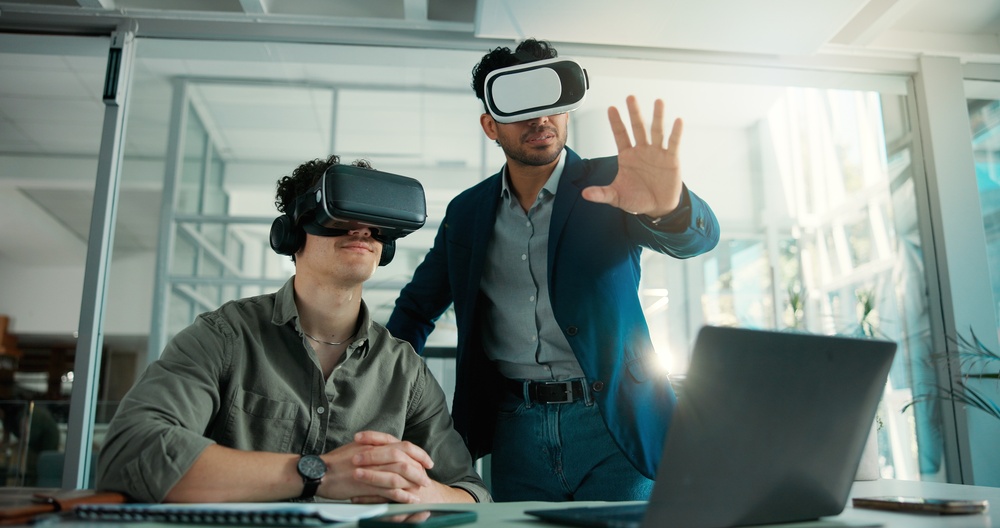
VR collaboration platforms create virtual workspaces where teams interact with spatial audio and 3D content. These environments are used by companies like PwC and NTT DATA for regular workflows.
Key Advantages
Immersive collaboration improves:
- Engagement during meetings
- Quality of discussions
- Ability to work with 3D models
This is especially useful for:
- Design reviews
- Planning sessions
- Technical discussions requiring spatial context
Mixed reality adds another layer by allowing teams to interact with shared virtual models, which is valuable in engineering and architecture.
Use Case 4: Healthcare Applications
Healthcare is the fastest-growing sector for XR adoption.
Clinical Training and Surgery
AR and VR are used for surgical planning and training. Solutions like SentiAR provide 3D visualizations during procedures, while platforms like PrecisionOS allow surgeons to practice before operating.
Medical professionals can repeat complex procedures without risk to patients, improving outcomes and readiness.
Patient Care
XR is also used for:
- Pain management
- Rehabilitation
- Therapy for anxiety and phobias
The combination of clinical effectiveness and scalability is driving strong adoption.
Use Case 5: Digital Twins and Product Design
XR is changing how organizations interact with complex systems.
Digital Twins
Digital twins are virtual representations of physical assets. Using VR, engineers can walk through these environments, identify issues, and test changes before applying them in real life.
This improves:
- Maintenance planning
- Process optimization
- Infrastructure management
Product Development
In design workflows, teams can review and modify 3D models without creating physical prototypes.
Benefits include:
- Faster design cycles
- Lower development costs
- Better collaboration across locations
This approach is widely used in automotive, construction, and consumer electronics.
Use Case 6: Retail and Customer Experience
Retail has shifted from novelty to measurable impact.
Customer-Facing AR
Customers can visualize products in their environment before buying. This improves conversion rates and reduces returns, which is critical for online retail.
Common uses include:
- Furniture placement
- Apparel try-ons
- Product previews
In-Store and Operations
Retail teams also use AR for:
- Shelf arrangement verification
- Inventory management
- Employee training
These applications support both customer experience and operational efficiency.
The Hardware Landscape
The hardware ecosystem has become more stable and practical.
Key players include:
- Meta Quest 3, widely used for enterprise VR
- Apple Vision Pro for high-end use cases
- Microsoft HoloLens and Magic Leap for industrial AR
- Smart glasses for lighter, everyday tasks
Enterprise programs now include device management, app distribution, and security controls, making large-scale deployments manageable.
Deployment Challenges
Despite progress, challenges remain.
1. Pilot to Production Gap
Many projects fail because they do not move beyond pilot stages. Successful programs define clear KPIs and demonstrate ROI quickly.
2. Network Readiness
XR applications require stable, low-latency connections. Infrastructure must be assessed before rollout.
3. Device and Content Management
Organizations must plan for:
- Device updates and maintenance
- Content development costs
VR training modules can cost tens of thousands of dollars, so prioritization is critical.
4. Change Management
Adoption depends on user readiness. Employees need training and support to use new tools effectively.
Building the Business Case
XR programs succeed when tied to measurable outcomes.
Key Metrics
For training:
- Reduced training time
- Improved retention
- Lower error rates
For AR operations:
- Faster task completion
- Fewer mistakes
- Reduced travel costs
For collaboration:
- Lower travel expenses
- Faster decision-making
Organizations that focus on operational results rather than technology features are more likely to scale successfully.
Conclusion
AR and VR are no longer emerging tools. They are part of enterprise infrastructure, integrated into daily operations and evaluated like any other system.
The strongest use cases in 2026 include training, frontline operations, collaboration, healthcare, digital twins, and retail experiences. These are not experiments but established deployments with measurable results.
For organizations that have watched from the sidelines, the opportunity is clear. The technology has matured, the data is available, and the path to implementation is better defined. The focus now should be on where it fits into business operations and how quickly it can be adopted.
Stay up to date with the latest in enterprise technology, AI, automation, and emerging tech at BusinessWorldIT.com.