Introduction
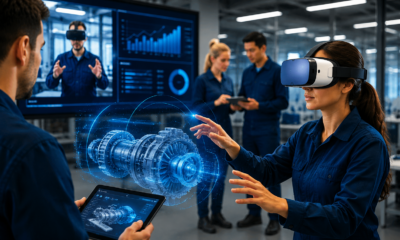
For years, spatial computing conversations were dominated by headset launches, futuristic demos, and predictions about the next breakthrough device. While these discussions generated excitement, they often overlooked a more important question for enterprises: ‘How can spatial technologies improve business operations today?’ Spatial computing is moving beyond pilot projects and finding practical applications across manufacturing, healthcare, logistics, construction, and engineering.
Organizations are using it to support workforce training, guide complex tasks, improve collaboration, and reduce operational errors. With the global spatial computing market expanding rapidly, enterprises are increasingly evaluating investments based on measurable outcomes rather than novelty. The real value lies not in the hardware itself, but in the ability to place digital information within physical environments and help employees make better decisions where work happens.
What Spatial Computing Means for Enterprises
A Definition Beyond Wearable Devices
Spatial computing refers to technologies that understand, map, and interact with physical spaces in three dimensions. The category includes:
- Augmented Reality (AR)
- Mixed Reality (MR)
- Virtual Reality (VR)
- Digital Twins
- Computer Vision
- Spatial Mapping
- Real-time 3D Visualization
Headsets are only one way of accessing these capabilities. Smartphones, tablets, sensors, cameras, connected equipment, and digital twin platforms also play critical roles. At its core, spatial computing connects digital information with physical locations, objects, and workflows.
Why Traditional Screens Have Limitations
Many enterprise tasks occur in physical environments where workers constantly move between equipment, documents, and digital systems.
Spatial computing addresses this challenge by:
- Presenting information directly within the worker’s field of view
- Reducing task switching between screens and physical assets
- Delivering visual guidance during complex procedures
- Making three-dimensional data easier to understand
- Supporting hands-free access to operational information
This approach can reduce cognitive load and improve task accuracy, especially in environments where mistakes carry significant costs.
Industries Driving Real Adoption
Manufacturing Leads the Way
Manufacturing remains one of the most mature spatial computing markets. Workers assembling, inspecting, or maintaining equipment often rely on manuals, diagrams, and standard operating procedures. Spatial overlays can place these instructions directly on machines and components.
Key benefits include:
- Faster maintenance procedures
- Lower error rates
- Improved quality inspections
- Reduced downtime
- Faster onboarding of new employees
Digital work instructions have become one of the strongest business cases for enterprise AR deployments.
Healthcare Expands Practical Applications
Healthcare organizations have moved beyond experimentation and are using spatial computing across multiple functions.
Clinical Training
Medical students and clinicians can practice procedures in simulated environments without risking patient safety.
Benefits include:
- Repeatable learning experiences
- Objective performance tracking
- Faster skill development
- Lower training costs
Surgical Planning
Three-dimensional patient models help surgeons visualize anatomy before procedures. This improves understanding of complex cases and supports more informed treatment planning.
Logistics and Warehousing
Warehouse operators increasingly use spatial technologies for:
- Picking and packing guidance
- Inventory management
- Route optimization
- Workforce training
By displaying item locations and instructions within workers’ field of view, organizations can increase efficiency while reducing fulfilment errors.
Construction and Infrastructure
Construction projects involve large volumes of spatial data that are often difficult to interpret using conventional drawings.
Spatial computing enables teams to:
- Visualize BIM models on-site
- Compare designs with actual construction progress
- Detect clashes before installation
- Improve collaboration across stakeholders
These capabilities can reduce costly rework during project execution.
The Rise of Digital Twins
Why Digital Twins Matter
Digital twins are rapidly becoming one of the most valuable enterprise applications of spatial computing. A digital twin is a virtual representation of a physical asset, process, facility, or environment.
Examples include:
- Manufacturing plants
- Office buildings
- Airports
- Utility networks
- Smart cities
When combined with IoT sensors and analytics platforms, digital twins provide real-time visibility into operations.
Business Benefits
Digital twins help organizations:
- Monitor asset performance
- Predict maintenance requirements
- Test operational scenarios
- Optimize resource utilization
- Improve decision-making
As enterprise AI capabilities mature, digital twins are becoming important environments for simulation and operational planning.
Apple Vision Pro’s Role in Enterprise Computing
What Makes Vision Pro Different
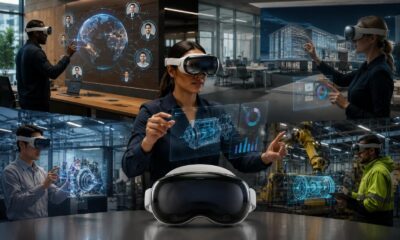
Apple Vision Pro introduced a different approach to mixed reality by combining high-resolution displays, eye tracking, hand tracking, and voice interaction.
The device is designed as a spatial computer rather than a traditional headset.
Its strongest enterprise advantages include:
- Exceptional visual clarity
- Controller-free interaction
- Familiar Apple ecosystem integration
- Enterprise mobility management support
- High-quality collaboration experiences
Where Enterprises Are Finding Value
- Executive and Knowledge Work
Vision Pro can create expansive virtual workspaces for professionals handling multiple applications and datasets simultaneously. - Design and Engineering Reviews
Teams can review 3D models at full scale without requiring dedicated immersive facilities. - Clinical Education
Healthcare institutions are exploring Vision Pro for anatomy visualization and procedural training programs.
Practical Limitations
Despite its capabilities, Vision Pro faces several adoption challenges:
- High acquisition costs
- Limited battery duration
- Device sharing complexities
- Restricted scalability for large frontline workforces
As a result, Vision Pro is best suited for premium use cases where visual quality directly affects outcomes.
A Growing Enterprise Device Ecosystem
Beyond Apple
The enterprise spatial computing market includes several specialized vendors.
- Varjo
Varjo serves industries such as:- Aviation
- Defence
- Automotive engineering
Its ultra-high-resolution devices support advanced simulation and design workflows.
- Microsoft HoloLens Legacy Deployments
Although Microsoft’s hardware roadmap has evolved, many organizations continue using HoloLens-based solutions for industrial and field-service applications. - Magic Leap
Magic Leap remains focused on enterprise deployments in sectors requiring collaborative visualization and operational guidance. - Industrial AR Providers
Companies including RealWear continue focusing on ruggedized devices designed for frontline workers operating in challenging industrial environments.
The growing variety of devices indicates that enterprises are increasingly selecting hardware based on workflow requirements rather than consumer popularity.
The Role of AI in Spatial Computing
Making Spatial Systems Smarter
Artificial intelligence is becoming a major force behind spatial computing platforms.
AI enables:
- Object recognition
- Context awareness
- Natural language interaction
- Real-time translation
- Automated workflow guidance
Instead of simply displaying information, future systems can understand what users are doing and provide relevant assistance.
AI-Powered Training
Training platforms now use AI to:
- Track user behavior
- Measure performance
- Detect mistakes
- Generate feedback
- Personalize learning experiences
This combination creates more effective learning environments than conventional classroom training.
The Real Challenges Holding Back Adoption
1. Cost and ROI Concerns
Many organizations struggle to justify large-scale deployments because benefits are not always immediately visible. Successful programmes typically start with high-value workflows where improvements can be measured clearly.
2. Change Management
Technology adoption often fails because employees resist changing familiar processes.
Effective implementations require:
- Executive sponsorship
- Structured training programmes
- Continuous support
- Clear success metrics
3. Integration Complexity
Spatial computing solutions must work alongside existing enterprise systems, including:
- ERP platforms
- Asset management systems
- Product lifecycle management tools
- Collaboration software
- Data platforms
Without integration, spatial applications risk becoming isolated technology investments.
4. Security and Governance
As spatial systems capture environmental and operational data, organizations must address concerns around:
- Data privacy
- Regulatory compliance
- Intellectual property protection
- Access controls
Governance frameworks are becoming increasingly important as deployments expand.
Building a Successful Spatial Computing Strategy
1. Start with Business Outcomes
Rather than beginning with device selection, organizations should identify operational challenges that spatial computing can address.
Examples include:
- Maintenance efficiency
- Workforce training
- Design collaboration
- Inspection accuracy
- Field service productivity
2. Prioritize Measurable Use Cases
The strongest deployments typically target metrics such as:
- Reduced downtime
- Lower error rates
- Faster onboarding
- Improved asset utilization
- Higher productivity
3. Scale Gradually
Most successful enterprises follow a phased approach:
- Identify a high-impact workflow.
- Launch a focused pilot.
- Measure operational outcomes.
- Expand additional teams. additional teams.
Standardize governance and support.
This reduces risk while building organizational confidence.
Conclusion
Spatial computing is entering a more practical phase of enterprise adoption. The industry is moving beyond hardware discussions and focusing on measurable business value. Manufacturing, healthcare, logistics, construction, and infrastructure organizations are already using spatial technologies to enhance training, reduce errors, improve collaboration, and support more informed decision-making.
The long-term opportunity extends far beyond headsets. Advances in digital twins, AI-powered assistance, spatial analytics, and real-time visualization are creating new ways for organizations to connect digital information with physical operations.
The enterprises most likely to succeed will not be those chasing the latest device release. They will be the ones that identify operational challenges, align spatial technologies with business objectives, and scale deployments based on proven results. In that environment, spatial computing becomes less about immersive experiences and more about improving how work gets done.
FAQs
1. What is spatial computing in an enterprise environment?
Spatial computing combines technologies such as AR, VR, mixed reality, computer vision, and digital twins to connect digital information with physical environments, helping employees perform tasks more effectively.
2. Which industries are adopting spatial computing most rapidly?
Manufacturing, healthcare, logistics, construction, aviation, engineering, and infrastructure sectors are leading to adoption due to their reliance on physical workflows, visual data, and complex operational processes.
3. Is spatial computing only about headsets?
No. Headsets are one access point. Spatial computing also includes digital twins, computer vision systems, mobile devices, sensors, AI platforms, and real-time 3D visualization tools.
4. What are the biggest challenges in enterprise deployment?
Key challenges include implementation costs, integration with enterprise systems, user adoption, security requirements, governance concerns, and building clear business cases with measurable returns.
5. How does AI enhance spatial computing applications?
AI enables object recognition, context-aware assistance, automated guidance, performance tracking, predictive insights, and personalized training experiences that improve operational efficiency and decision-making.
6. How should organizations start their spatial computing journey?
Enterprises should begin with a specific operational problem, run targeted pilots, measure business outcomes, integrate with existing systems, and expand deployments based on demonstrated value.