Additive manufacturing has changed the way products are designed and produced across industries such as aerospace, healthcare, automotive, and consumer goods. While much attention is given to the printing process, the work does not end when a part comes off the printer.
Most 3D-printed components require additional steps such as cleaning, support removal, surface treatment, finishing, and inspection before they are ready for use. Overlooking these activities can lead to higher costs, production delays, and inconsistent quality. As additive manufacturing continues expanding into production environments, post-processing has become a crucial factor in achieving reliable and high-quality results.
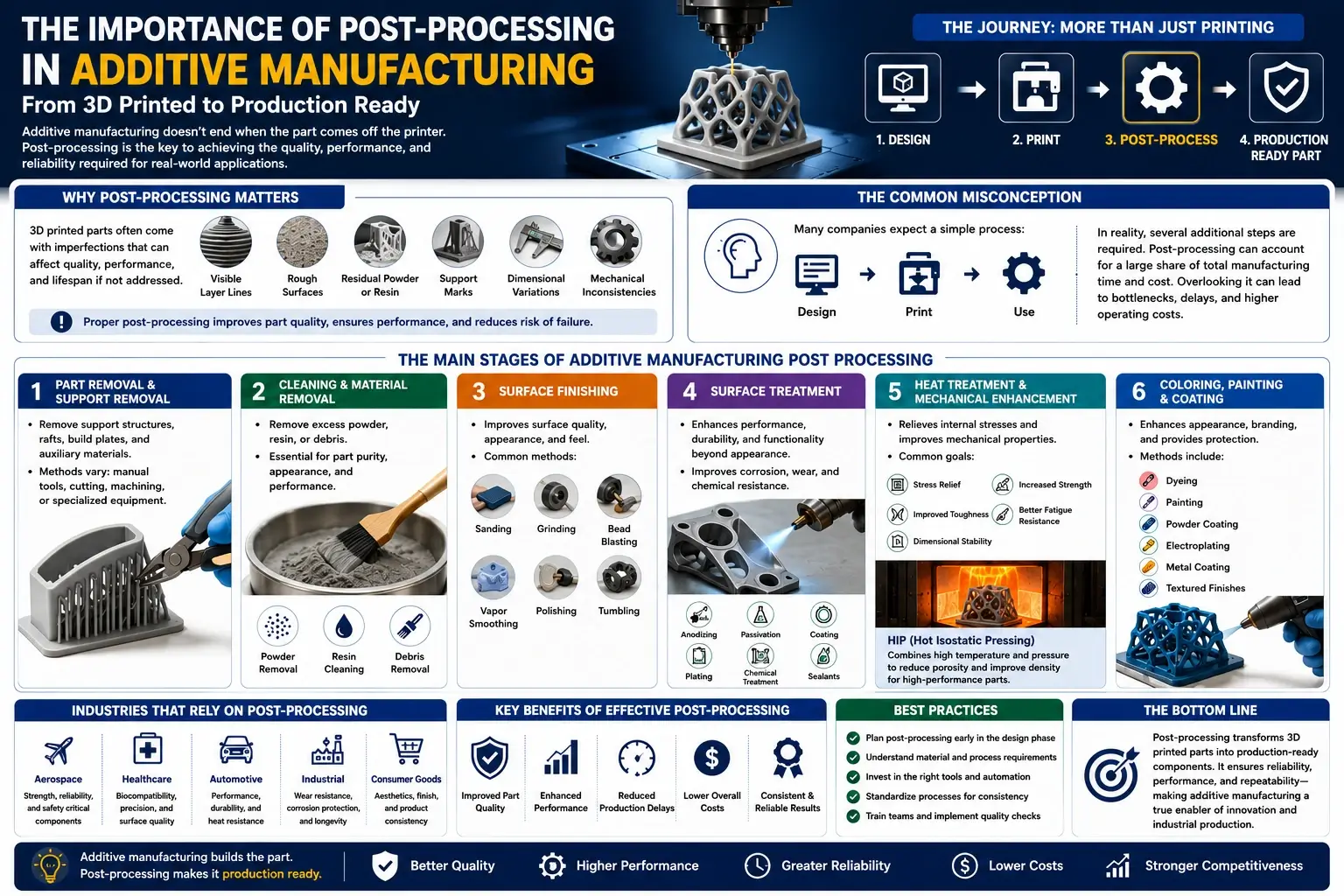
Why Post-Processing Matters in Additive Manufacturing
Additive manufacturing builds parts layer by layer, allowing the creation of complex geometries that are difficult to achieve with traditional manufacturing methods. However, printed parts often come with imperfections such as:
- Visible layer lines
- Rough surface textures
- Residual powder or resin
- Support marks
- Dimensional variations
- Mechanical property inconsistencies
Without proper additive manufacturing post processing, these issues can affect a part’s quality, performance, and lifespan. For example, medical components may require smoother surfaces, while aerospace parts often need heat treatment. In many applications, 3D printing finishing surface treatment plays a key role in improving both functionality and appearance.
The Common Misconception Around 3D Printing
Many companies adopt additive manufacturing expecting a straightforward process:
- Design the part
- Print the part
- Use the part
In reality, several additional steps are required before a part is ready for production use. Additive manufacturing post processing can account for a large share of overall manufacturing time and cost, depending on the technology and application.
This often comes as a surprise during the early stages of adoption. As production volumes grow, manual finishing operations can become bottlenecks. Companies may invest in advanced printers but overlook the resources needed for post-processing, resulting in slower production and higher operating costs.
Understanding the Main Stages of Additive Manufacturing Post Processing
Additive manufacturing post processing involves several steps that vary based on the printing technology, material, and application requirements.
1. Part Removal and Support Removal
Many 3D printing technologies use support structures during the build process to maintain stability. After printing, operators remove:
- Support structures
- Rafts
- Build plates
- Auxiliary materials
In FDM printing, supports are often removed manually, while metal parts may require cutting tools or specialized equipment. Improper removal can damage delicate features and affect dimensional accuracy.
2. Cleaning and Material Removal
Cleaning is an important step before further processing. Different technologies require different methods:
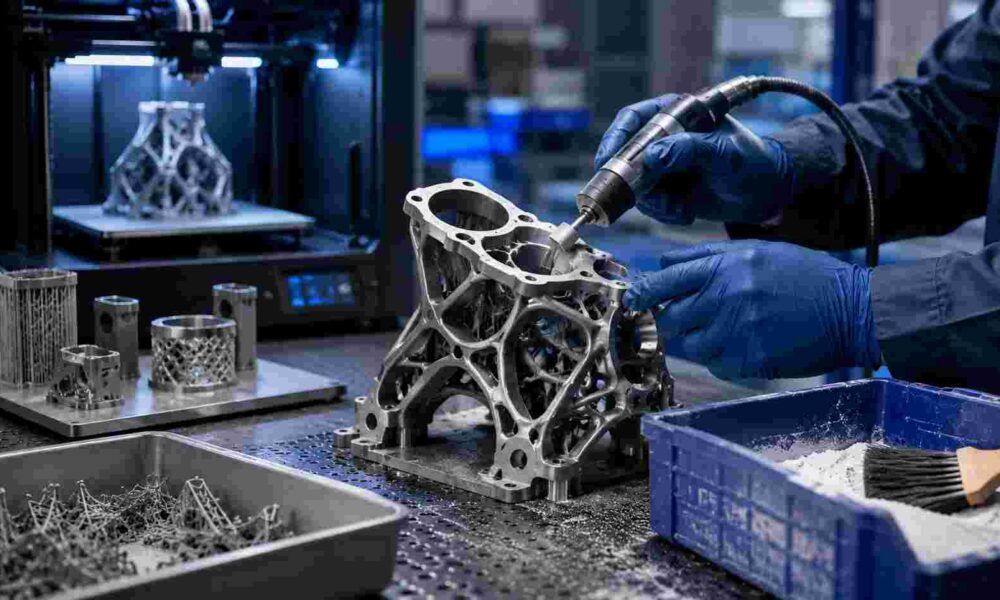
- Powder bed fusion parts need excess powder removal
- SLA parts require resin cleaning
- Metal parts may need debris removal
- Binder jet parts often require depowdering
Residual material can affect both appearance and performance, making thorough cleaning necessary.
3. Surface Finishing
Surface quality plays a major role in the final appearance of a printed component. Common 3D printing finishing surface treatment methods include:
- Sanding
- Grinding
- Bead blasting
- Vapor smoothing
- Polishing
- Tumbling
These techniques improve surface texture and help create production-ready parts. While rough finishes may be acceptable for prototypes, commercial products often require a smoother and more refined appearance.
Surface Treatment: Enhancing Performance Beyond Appearance
Many people associate post-processing with appearance, but 3D printing finishing surface treatment also improves part performance and durability.
1. Improving Corrosion Resistance
Metal parts used in challenging environments often require treatments such as anodizing, passivation, or protective coatings. These are commonly applied in:
- Aerospace
- Marine applications
- Industrial equipment
- Energy systems
2. Increasing Wear Resistance
Parts exposed to friction and repeated movement can be worn out over time. Surface hardening and protective coatings help increase service life and reduce maintenance needs.
3. Improving Chemical Resistance
Components used around fuels, solvents, and industrial chemicals benefit from surface treatments that protect against chemical damage and help maintain part integrity.
Heat Treatment and Mechanical Enhancement
Heat treatment is an important step for many metal additive manufacturing components. The printing process can create residual stresses that may affect strength, durability, and dimensional accuracy.
Common objectives of heat treatment include:
- Stress relief
- Increased strength
- Improved toughness
- Better fatigue resistance
- Greater dimensional stability
Materials such as titanium, stainless steel, aluminum, and nickel-based alloys require different thermal processing methods based on application needs.
Hot Isostatic Pressing (HIP)
For high-performance applications, Hot Isostatic Pressing (HIP) is often used. The process combines high temperature and pressure to reduce internal porosity and improve material density. Industries such as aerospace and medical manufacturing frequently use HIP to enhance part reliability and mechanical performance.
Coloring, Painting, and Coating
Many printed components require additional finishing to meet visual or branding requirements.
Popular methods include:
- Dyeing
- Painting
- Powder coating
- Electroplating
- Metal coating
- Textured finishes
These treatments improve the appearance of printed parts while adding protection against environmental exposure. In industrial applications, coatings may also provide wear resistance, electrical conductivity, or specific thermal properties, depending on the product’s intended use.
Quality Inspection: A Frequently Overlooked Step
Post-processing does not end with finishing. Inspection and validation are essential parts of the workflow.
Common inspection activities include:
- Dimensional measurement
- Surface quality evaluation
- Mechanical testing
- Non-destructive testing
- Visual assessment
The finished part must meet both engineering and performance requirements. Inspection helps identify defects and confirms that the component is ready for its intended application.
The Cost Impact of Poor Post-Processing Planning
When companies underestimate additive manufacturing post processing, several challenges can arise.
1. Production Delays
Printing may take only a few hours, but finishing activities can add significant time to production. Limited post-processing capacity can create backlogs as printed parts accumulate.
2. Increased Labor Costs
Many post-processing tasks are still performed manually. As production volumes grow, labor expenses can increase rapidly.
3. Inconsistent Quality
Manual finishing methods can result in variations between parts, creating issues in applications that demand precision.
4. Reduced Return on Investment
Investing in advanced printers alone is not enough. If post-processing resources are inadequate, production output may suffer, reducing the overall benefits of additive manufacturing.
Automation Is Changing the Post-Processing Landscape
To handle larger production runs, many companies are introducing automation into their post-processing operations.
Modern solutions support:
- Automated support removal
- Robotic finishing
- Automated depowdering
- Chemical vapor smoothing
- Automated inspection
These technologies help reduce manual work and improve consistency. Key benefits include:
- Faster production
- Better repeatability
- Reduced human error
- Higher throughput
- Lower operating costs
Designing with Post-Processing in Mind
Many post-processing challenges can be reduced during the design stage. Engineers can do this by:
- Minimizing support structures
- Optimizing part orientation
- Designing accessible surfaces
- Planning finishing requirements early
- Selecting materials based on application needs
Design choices affect every stage that follows. When design, printing, and post-processing teams work together from the beginning, production becomes more efficient, and costly rework can often be avoided.
The Future of Additive Manufacturing Post Processing
Innovation in additive manufacturing post processing is focused on making production faster and more consistent. Key developments include:
- Greater automation
- Faster finishing techniques
- Improved quality monitoring
- More connected production systems
- Reduced manual effort
As 3D printing adoption grows across industries, post-processing will continue to play a major role in part quality, production speed, and manufacturing costs.
Conclusion
Additive manufacturing has expanded the possibilities of product design and production, but printing alone does not determine the final outcome. The quality and performance of a component often depend on additive manufacturing post processing steps carried out after printing.
From support removal and cleaning to heat treatment, coating, inspection, and 3D printing finishing surface treatment, these processes help prepare parts for real-world use. Companies that overlook post-processing often face delays, rising costs, and quality issues. As additive manufacturing production grows, post-processing is becoming an essential part of delivering reliable, production-ready components across industries.
FAQs
1. What is additive manufacturing post processing?
Additive manufacturing post processing includes all activities performed after printing, such as cleaning, support removal, surface finishing, heat treatment, coating, inspection, and preparation for final use.
2. Why is post-processing important in 3D printing?
Post-processing improves surface quality, dimensional accuracy, mechanical performance, and appearance. It helps printed parts meet functional requirements, industry standards, and customer expectations for finished products.
3. What are the most common 3D printing finishing methods?
Popular finishing methods include sanding, polishing, bead blasting, vapor smoothing, tumbling, painting, and coating. The method depends on material type and application requirements.
4. Does post-processing increase additive manufacturing costs?
Yes, post-processing adds labor, equipment, and material costs. However, it improves product quality, reduces defects, and supports reliable performance in production environments.
5. What is surface treatment in additive manufacturing?
Surface treatment involves applying processes or coatings that improve corrosion resistance, wear resistance, appearance, and functionality while helping parts perform better in demanding applications.
6. Can post-processing be automated?
Many post-processing activities can be automated, including depowdering, support removal, finishing, and inspection. Automation improves consistency, throughput, and productivity in large-scale manufacturing operations.
7. Which industries rely heavily on additive manufacturing post-processing?
Industries such as aerospace, medical devices, automotive, industrial manufacturing, defense, and consumer products depend heavily on post-processing to achieve required quality and performance standards.