Introduction
Manufacturing has spent years adopting digital tools, but most changes improved efficiency rather than transforming how production works.
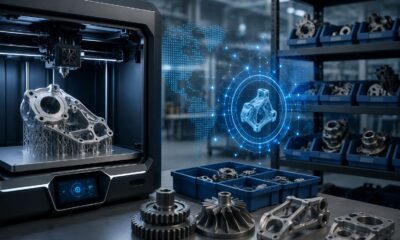
In 2026, 3D printing shifted from a prototyping tool to a production method. What began to visualize designs is now used to create final parts across industries. At the same time, 4D materials are introducing a new capability, where printed objects can change shape or function after production. Together, these technologies are changing how products are designed, produced, and delivered.
Part 1: 3D Printing as Production Infrastructure
The Shift from Prototype to Production
The core question in 2026 is no longer about whether 3D printing works. It is about reliability, repeatability, and cost at scale. Manufacturers now evaluate additive systems based on utilization and output quality. A small number of machines running continuously on production parts is more valuable than a large fleet used occasionally.
Advances in materials and machine performance have expanded the range of applications. Industrial polymers and metal printing now meet requirements for durability, consistency, and performance.
Aerospace: Lightweight and Consolidated Design
Aerospace continues to lead in additive manufacturing adoption. The ability to create lighter parts without sacrificing strength reduces fuel consumption and operational costs. More importantly, multiple components can now be printed as a single unit.
This reduces:
- Assembly work
- Points of failure
- Supply chain complexity
Production timelines are also shorter. New parts can be produced within days rather than weeks, which supports faster design cycles and rapid deployment.
Healthcare: Customization at Scale
Healthcare applications focus on personalized manufacturing. 3D printing enables patient-specific products such as:
- Dental aligners and prosthetics
- Surgical guides
- Orthopedic implants
These parts are tailored to individual anatomy and can be produced quickly. This reduces waiting times and improves treatment outcomes.
Regulatory frameworks have improved, making it easier for medical organizations to use additive manufacturing in regulated environments.
Automotive: Tooling and Supply Chain Flexibility
The automotive sector uses additive manufacturing across three main areas.
Tooling and fixtures
Custom tools can be produced quickly, reducing downtime and improving production efficiency.
Customization
Manufacturers can produce limited-run or personalized components without significant tooling investments.
Digital inventory
Companies store design files instead of physical parts and produce components on demand. This reduces storage costs and improves supply chain flexibility.
Defence: Strategic Adoption
Defence organizations are investing heavily in additive manufacturing.
The main advantage is the ability to produce parts near operational environments. Instead of relying on long supply chains, parts can be manufactured on demand using digital designs.
This improves readiness and reduces dependence on centralized production systems.
4D Materials and Adaptive Manufacturing
What 4D Printing Means
3D printing produces fixed objects. 4D printing introduces materials that respond to external conditions such as heat, moisture, or light. These materials can change shape or properties after printing.
This allows engineers to create components that adapt over time or in response to their environment.
Key Applications
1. Medical Devices
4D materials are used in applications such as self-expanding stents. These devices can be inserted in a compact form and expand once inside the body.
Other developments include:
- Adaptive implants
- Drug delivery systems
- Tissue scaffolds
2. Aerospace Structures
Deployable components benefit from 4D printing. Parts can be transported in compact forms and expand into operational shapes when triggered.
This reduces space requirements during transport and lowers weight-related costs.
3. Robotics and Adaptive Systems
4D materials enable flexible robotic components.
Examples include:
- Grippers that adjust to different shapes
- Devices that change stiffness under load
These features reduce the need for complex mechanical systems.
4. Self-Healing Materials
Materials can be designed to recover their original shape after damage. This has potential in infrastructure and industrial components where maintenance is difficult.
5. Wearables and Textiles
Consumer applications include materials that adjust to body conditions or external environments, such as temperature-responsive clothing.
Current Limitations
4D printing is still in early stages.
Challenges include:
- High material costs
- Complex design requirements
- Limited large-scale production
Most applications are in research or early industrial use. Wider adoption will depend on improvements in materials and manufacturing processes.
Convergence with AI and Digital Systems
Integrated Manufacturing Systems
The real change comes when additive manufacturing is combined with digital technologies.
Modern manufacturing workflows include:
- AI-driven design
Algorithms generate optimized designs that reduce material use and improve performance. - Digital twin simulation
Virtual models test designs before production, reducing the need for physical prototypes. - Real-time monitoring
Sensors track the printing process and identify defects as they occur. - Digital inventory
Parts are stored as files and produced when needed, reducing reliance on physical storage.
This integration connects design, production, and supply chain into a continuous system.
What Enterprise Leaders Should Evaluate
1. Identify Practical Use Cases
Organizations should begin with specific challenges:
- Long lead times
- Supply chain risks
- High inventory costs
Additive manufacturing is most effective when applied to these problems.
2. Start with Tooling
Tooling and fixtures offer fast returns. They are easier to qualify and have immediate impact on production efficiency.
3. Invest in Materials Knowledge
Materials play a critical role in additive manufacturing. Understanding material properties and applications is essential for long-term success.
4. Approach 4D Strategically
4D materials should be considered only when there is a clear need for adaptive or responsive components.
Conclusion
3D printing in 2026 has moved into mainstream manufacturing. It is used for production parts across aerospace, healthcare, automotive, and defence. The focus has shifted from experimentation to operational deployment. At the same time, 4D materials introduce new possibilities for adaptive and responsive products. While still in the early stages, they represent an emerging area of innovation.
The most important shift is the integration of additive manufacturing with AI, digital twins, and connected systems. This creates a manufacturing model that is more flexible, more responsive, and better suited to complex production needs. Smart manufacturing is not defined by a single technology. It is defined by how these technologies work together to improve design, production, and supply chain operations.
Stay ahead of emerging technology, AI, automation, and smart manufacturing at BusinessWorldIT.com.