
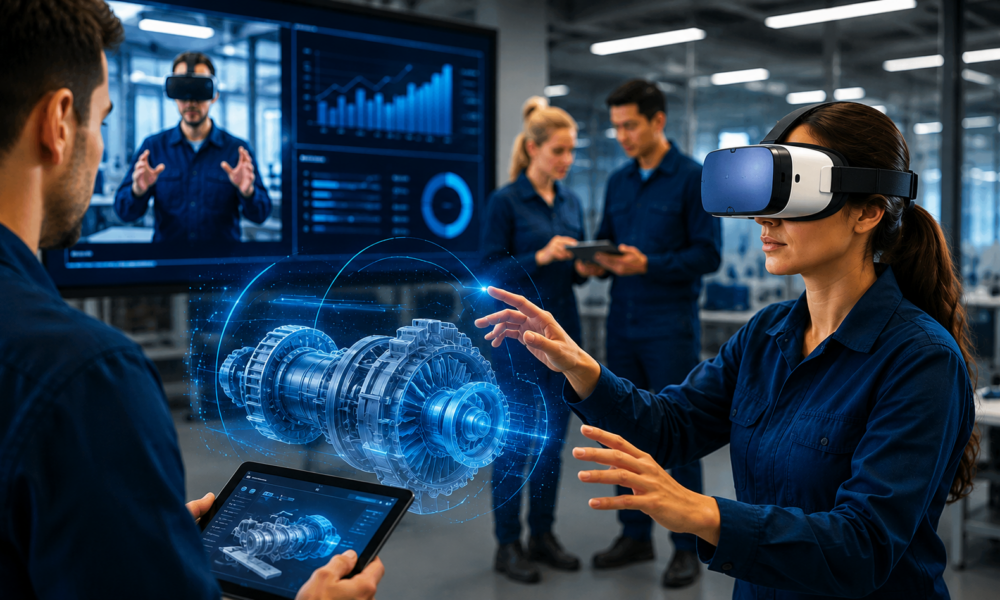
Extended Reality (XR), which combines Virtual Reality (VR), Augmented Reality (AR), and Mixed Reality (MR), is helping organizations create more immersive training experiences. Employees can practice equipment handling, safety procedures, customer interactions, and technical tasks in simulated environments that closely reflect actual working conditions. Industries such as manufacturing, healthcare, retail, and energy are using XR to support workforce development and hands-on learning.
As investments increase, organizations are paying closer attention to outcomes. A key question is how businesses can measure extended reality learning outcomes and evaluate XR corporate training ROI. Beyond participant feedback, decision-makers need data that links training performance with productivity, safety, operational efficiency, and other business objectives. This article examines the metrics and methods used to assess that value.
The Growing Role of XR in Corporate Learning
Organizations are looking beyond traditional training methods to provide employees with more practical learning experiences. XR allows learners to interact with virtual environments that replicate workplace situations, helping them apply knowledge rather than simply consuming information.
Some key benefits of XR training include:
- Immersive learning experiences
- Hands-on practice in safe environments
- Better knowledge retention
- Consistent training delivery across locations
- Real-time performance feedback
- Reduced reliance on physical equipment
For example, technicians can practice complex procedures virtually before working on actual systems, while healthcare professionals can rehearse clinical scenarios repeatedly. This approach helps employees build skills, confidence, and job readiness through active participation.
Measuring the Impact of XR Training
Organizations investing in XR training need clear evidence that it delivers value. Learning outcomes help measure whether employees are gaining knowledge, improving skills, and applying training on the job.
Measuring outcomes helps organizations:
- Assess training effectiveness
- Identify knowledge gaps
- Compare learning approaches
- Support investment decisions
- Link training to business goals
Without clear metrics, it becomes difficult to evaluate the real impact of an XR training program.
Understanding Extended Reality Learning Outcomes
Extended reality learning outcomes refer to the knowledge, skills, behaviors, and competencies employees develop after completing XR-based training. Unlike conventional learning methods, XR environments can capture detailed performance data, making it easier to assess how learners respond to tasks and scenarios.
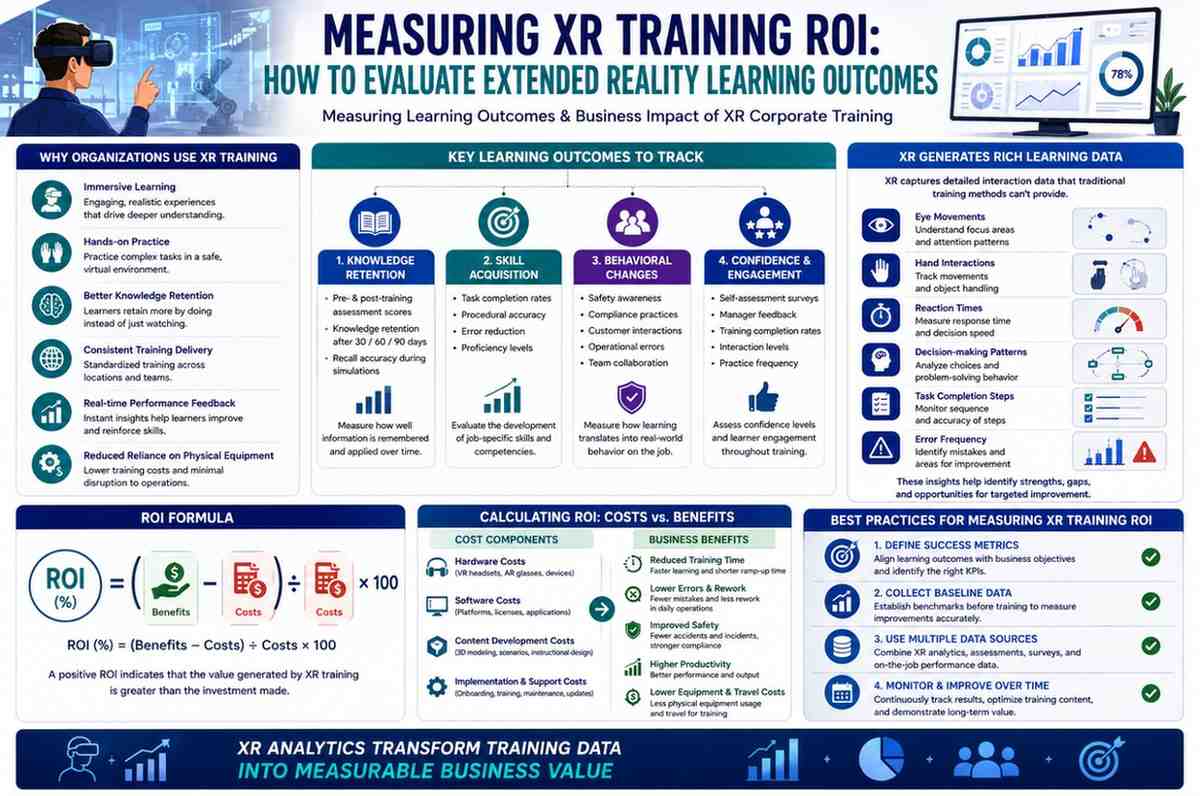
Key Learning Outcomes to Track
Knowledge Retention
Knowledge retention indicates how well employees remember and apply information over time. Organizations can evaluate:
- Pre- and post-training assessment scores
- Knowledge retention after 30, 60, or 90 days
- Recall accuracy during simulations
Skill Acquisition
Skill acquisition focuses on the development of job-specific capabilities. Common metrics include:
- Task completion rates
- Procedural accuracy
- Error reduction
- Proficiency levels
These indicators provide insight into how effectively employees perform after training.
Behavioral Changes
Training outcomes become meaningful when learning is reflected in day-to-day work. Organizations often monitor:
- Safety awareness
- Compliance practices
- Customer interactions
- Operational errors
- Team collaboration
Confidence and Engagement
Repeated practice in simulated environments can help employees become more confident when handling complex tasks. Additional indicators include:
- Self-assessment surveys
- Manager feedback
- Training completion rates
- Interaction levels
- Practice frequency
Together, these metrics help organizations evaluate learning effectiveness and identify areas that may require additional training or support.
How XR Generates Rich Learning Data
Traditional training often depends on quizzes, tests, and instructor feedback. XR provides a deeper view of learner performance by capturing detailed interaction data.
XR systems can track:
- Eye movements
- Decision-making patterns
- Hand interactions
- Reaction times
- Task completion steps
- Error frequency
This information helps organizations understand how employees perform in realistic scenarios. For example, a safety simulation can reveal whether a worker quickly identifies hazards or misses critical warning signs, offering insights that are difficult to capture through conventional training methods.
Building an ROI Framework for XR Corporate Training
Learning outcomes show whether training is effective, but organizations also need to measure business value. XR corporate training ROI compares the benefits generated with the investment made.
ROI (%) = (Benefits − Costs) ÷ Costs × 100
To calculate ROI accurately, organizations should account for both direct financial gains and broader operational benefits.
Calculating Training Costs
An ROI analysis should account for all costs associated with XR deployment. These typically include:
Hardware Costs
- VR headsets
- AR glasses
- Computing devices
- Tracking equipment
Software Costs
- XR learning platforms
- Content management systems
- Licensing fees
- Simulation applications
Content Development Costs
- 3D modeling
- Scenario design
- Instructional design
- Testing and validation
Implementation and Support Costs
- Employee onboarding
- Technical support
- System maintenance
- Software updates
Understanding these expenses helps organizations build a realistic picture of training investments and expected returns.
Measuring Financial Benefits
Once training costs are identified, organizations can assess the business value generated through XR programs. These benefits often contribute directly to XR corporate training ROI.
1. Reduced Training Time
XR allows employees to practice tasks in realistic simulations, helping them learn procedures more quickly.
Benefits may include:
- Faster onboarding
- Shorter instructor-led sessions
- Reduced travel costs
- More productive work hours
2. Lower Error Rates
Training in virtual environments gives employees the opportunity to learn from mistakes without affecting actual operations.
Potential gains include:
- Reduced product defects
- Fewer service errors
- Less material waste
- Improved quality standards
3. Improved Workplace Safety
Safety training is a common XR use case, particularly in high-risk industries.
Organizations may experience:
- Fewer workplace injuries
- Lower insurance expenses
- Reduced compliance-related issues
- Less downtime from accidents
4. Enhanced Productivity
When employees gain skills faster, they can perform tasks with greater accuracy and confidence.
Key indicators include:
- Higher output levels
- Faster task completion
- Better operational efficiency
- Quicker workforce readiness
5. Reduced Equipment Costs
XR simulations can reduce the need for repeated use of expensive equipment, materials, and physical training environments, helping organizations lower training-related expenses over time.
Linking Learning Outcomes to Business Results
The value of XR training becomes clearer when extended reality learning outcomes are linked to business performance.
For example, a manufacturing company introducing XR safety training may see higher safety assessment scores, fewer workplace incidents, reduced downtime, and lower insurance costs. Such results help organizations understand how training investments contribute to measurable operational and financial gains.
Using Analytics to Strengthen ROI Measurement
Many XR platforms include analytics tools that provide visibility into training performance. Organizations can track:
- Learner progress
- Knowledge retention trends
- Simulation completion rates
- Skill development
- Business impact metrics
By combining training data with operational performance metrics, organizations can better evaluate XR corporate training ROI and identify areas that need improvement.
Common Challenges in Measuring XR ROI
1. Long-Term Impact Assessment
Some training benefits, such as employee retention, leadership development, and skill growth, may take months to become visible. This can make ROI assessment more complex.
2. Data Integration Issues
Training data is often stored separately from operational and business performance data, making it difficult to create a complete picture of training impact.
3. Attribution Complexity
Business results are influenced by multiple factors, including new processes, equipment upgrades, and management decisions. When evaluating XR corporate training ROI, organizations need baseline measurements and comparison groups to identify the contribution of training more accurately.
Best Practices for Measuring XR Corporate Training ROI
1. Define Success Metrics Early
Organizations should set clear objectives before launching training programs. Metrics may include lower error rates, improved knowledge retention, shorter onboarding periods, or fewer safety incidents.
2. Collect Baseline Data
Measuring performance before training begins provides a useful benchmark for evaluating progress and identifying measurable improvements.
3. Use Multiple Data Sources
A broader assessment can include:
- Assessment scores
- Operational metrics
- Employee surveys
- Manager feedback
- Performance reviews
4. Monitor Results Over Time
Tracking performance after training helps organizations identify skill gaps, measure retention, and validate XR corporate training ROI more effectively.
The Future of XR Training Measurement
As XR technologies continue to advance, organizations are expected to gain deeper insights into training performance. Tools such as predictive analytics and biometric tracking could help measure factors like attention levels, decision-making patterns, and competency development. These capabilities may support more accurate assessment of extended reality learning outcomes and training effectiveness.
Conclusion
XR is helping organizations deliver training that is more interactive, practical, and closely aligned with workplace requirements. While immersive experiences can improve engagement, their value is best understood through measurable outcomes. By tracking extended reality learning outcomes, organizations can assess knowledge retention, skill development, behavioral changes, and job performance.
When these results are connected to metrics such as productivity, safety, and cost savings, businesses can calculate XR corporate training ROI more effectively. As analytics capabilities improve, organizations gain better visibility into training impact, making it easier to support workforce development goals and demonstrate the business value of XR-based learning programs.
FAQs
1. What is XR corporate training ROI?
XR corporate training ROI measures the business value generated by immersive training programs compared to the total investment in hardware, software, content creation, deployment, and ongoing support activities.
2. How do organizations measure extended reality learning outcomes?
Organizations measure extended reality learning outcomes through assessment results, skill proficiency scores, simulation performance, knowledge retention, behavioral improvements, task accuracy, and workplace performance indicators after training.
3. Which industries benefit most from XR training?
Industries such as manufacturing, healthcare, aviation, energy, construction, logistics, and retail benefit from XR training because employees can safely practice complex tasks and procedures.
4. Can XR training improve employee engagement?
Yes. XR training encourages active participation through immersive scenarios, hands-on learning, and realistic simulations, helping employees remain focused and involved throughout the training process.
5. What metrics are commonly used to calculate XR ROI?
Organizations commonly use metrics such as training time reduction, lower error rates, fewer safety incidents, productivity improvements, operational efficiency gains, and cost savings.
6. Why is data analytics important in XR training?
Data analytics helps organizations evaluate learner performance, identify skill gaps, track knowledge retention, and connect training outcomes with operational and business performance metrics.
7. Is XR training suitable for employee onboarding?
Yes. XR-based onboarding allows new employees to explore realistic work environments, practice job-related tasks, and become familiar with procedures before performing them independently.

