As additive manufacturing advances, manufacturers are expanding beyond single-material processes and adopting multi material 3D printing 2026 for more complex applications. By combining different materials within a single build, engineers can produce parts with multiple functions, improved mechanical properties, and greater design flexibility. Components that previously required separate manufacturing and assembly can now be created as integrated structures.
The technology is finding applications across healthcare, aerospace, automotive, electronics, and consumer products. Its growing role in functional prototype additive manufacturing is helping companies develop and test products that more closely match real-world performance requirements.
Understanding Multi-Material 3D Printing
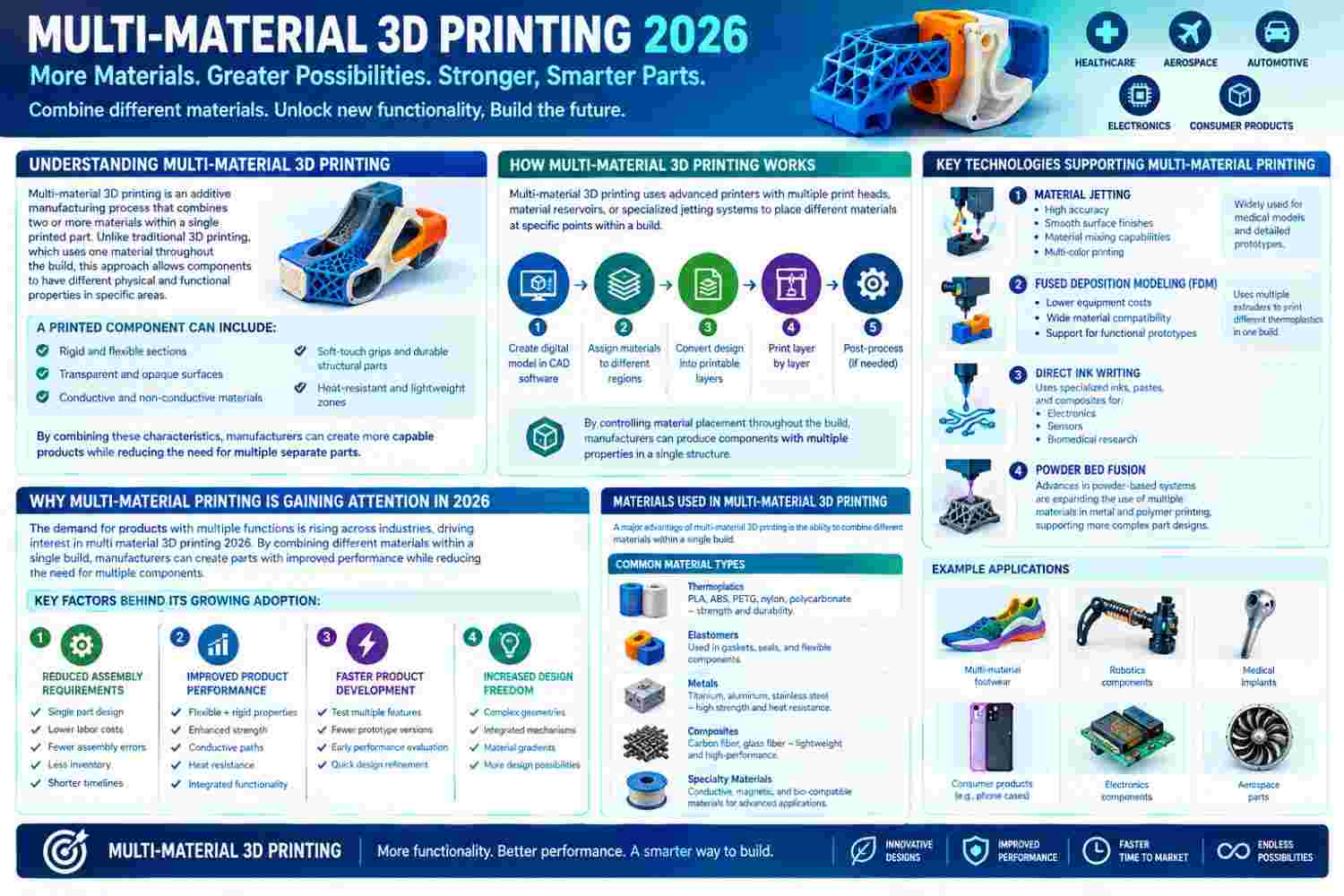
Multi-material 3D printing is an additive manufacturing process that combines two or more materials within a single printed part. Unlike traditional 3D printing, which uses one material throughout the build, this approach allows components to have different physical and functional properties in specific areas.
A printed component can include:
- Rigid and flexible sections
- Transparent and opaque surfaces
- Conductive and non-conductive materials
- Soft-touch grips and durable structural parts
- Heat-resistant and lightweight zones
By combining these characteristics in one build, manufacturers can create more capable products while reducing the need for multiple separate parts.
How Multi-Material 3D Printing Works
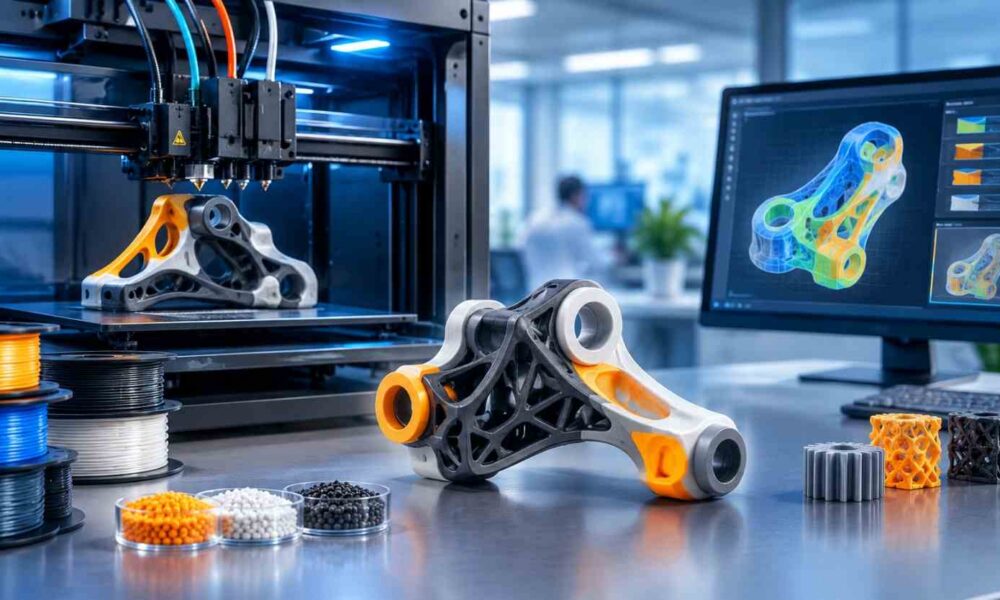
Multi-material 3D printing relies on advanced printers equipped with multiple print heads, material reservoirs, or specialized jetting systems. These machines place different materials at specific points within a build to create a single functional part.
The process typically involves:
- Creating a digital model in CAD software
- Assigning materials to different regions
- Converting the design into printable layers
- Printing the part layer by layer
- Completing any required post-processing
By controlling material placement throughout the build, manufacturers can produce components with multiple properties in a single structure.
Key Technologies Supporting Multi-Material Printing
Several additive manufacturing technologies support multi-material printing, each suited to different applications.
1. Material Jetting
Material jetting deposits photopolymer droplets and cures them using ultraviolet light. It offers:
- High accuracy
- Smooth surface finishes
- Material mixing capabilities
- Multi-color printing
It is widely used for medical models and detailed prototypes.
2. Fused Deposition Modeling (FDM)
Multi-material FDM printers use multiple extruders to print different thermoplastics in one build. Key advantages include:
- Lower equipment costs
- Wide material compatibility
- Support for functional prototypes
3. Direct Ink Writing
This method uses specialized inks, pastes, and composites for applications such as:
- Electronics
- Sensors
- Biomedical research
4. Powder Bed Fusion
Advances in powder-based systems are expanding the use of multiple materials in metal and polymer printing, supporting more complex part designs.
Why Multi-Material Printing Is Gaining Attention in 2026
The demand for products with multiple functions is rising across industries, driving interest in multi material 3D printing 2026. By combining different materials within a single build, manufacturers can create parts with improved performance while reducing the need for multiple components.
Key factors behind its growing adoption include:
1. Reduced Assembly Requirements
- Combines multiple components into a single part
- Reduces labor costs
- Minimizes assembly errors
- Lowers inventory requirements
- Shortens production timelines
2. Improved Product Performance
- Flexible sections improve comfort and usability
- Rigid areas provide structural strength
- Conductive paths support electrical functions
- Heat-resistant materials protect sensitive components
- Multiple properties can be integrated into one product
3. Faster Product Development
- Supports testing of multiple features in a single prototype
- Reduces the need for separate prototype versions
- Helps evaluate performance earlier in development
- Speeds up design refinement and validation
4. Increased Design Freedom
- Enables complex geometries
- Supports integrated mechanisms and moving features
- Allows the use of material gradients
- Expands design possibilities beyond conventional manufacturing methods
Materials Used in Multi-Material 3D Printing
A major advantage of multi-material 3D printing is the ability to combine different materials within a single build.
Common Material Types
- Thermoplastics such as PLA, ABS, PETG, nylon, and polycarbonate provide strength and durability.
- Elastomers are used in gaskets, seals, wearable products, and shock-absorbing components.
- Photopolymers support detailed models, transparent parts, and production-like prototypes.
- Conductive materials enable embedded circuits, sensors, and electronic prototypes.
- Metal and composite materials offer high strength, heat resistance, and lightweight performance for advanced applications.
These material combinations allow manufacturers to create parts with multiple functional properties in a single component.
Applications Across Industries
Multi-material printing is being adopted across industries where products require a combination of strength, flexibility, durability, or electrical functionality.
1. Healthcare and Medical Devices
Applications include:
- Surgical planning models
- Prosthetics
- Orthotic devices
- Dental products
Different materials can replicate both hard and soft biological structures, helping improve medical planning and product customization.
2. Automotive Industry
Common applications include:
- Dashboard prototypes
- Interior components
- Custom seals
- Functional testing parts
Multiple material properties can be incorporated into a single component.
3. Aerospace Sector
Manufacturers use the technology for:
- Weight reduction
- Component consolidation
- Functional prototypes
- Performance testing
Fewer parts can contribute to improved reliability and easier maintenance.
4. Consumer Products
Examples include:
- Custom eyewear
- Sports equipment
- Wearable devices
- Electronic accessories
Designers can combine comfort, appearance, and performance within one product.
5. Electronics Manufacturing
Key applications include:
- Printed circuit structures
- Sensors
- Smart devices
- Electronic prototypes
Combining conductive and insulating materials opens new possibilities for compact electronic designs.
Advantages of Multi-Material 3D Printing
The growing adoption of multi-material 3D printing comes from its ability to combine multiple functions within a single component.
1. Component Consolidation
- Combines multiple parts into one printed object
- Reduces assembly requirements
- Lowers production costs
- Improves product reliability
2. Enhanced Functionality
- Supports flexible joints
- Integrates built-in seals
- Incorporates conductive pathways
- Adds shock-absorbing features
3. Customization
- Allows material placement based on product needs
- Useful for medical devices, industrial tools, and wearable products
4. Faster Development
- Produces realistic prototypes quickly
- Helps identify design issues early
- Supports faster product testing and refinement
Challenges Facing Multi-Material Printing
- Different materials may not bond effectively, which can affect part quality and durability.
- Variations in thermal expansion and melting temperatures may create performance issues.
- Multi-material systems often require significant investment in hardware and software.
- Material handling and storage can increase operational costs.
- Designing parts with multiple materials requires careful planning and technical expertise.
- Transition zones between materials must be optimized for reliability.
- Some applications require additional post-processing to improve surface finish and functional performance.
Emerging Trends in Multi Material 3D Printing 2026
Interest in multi material 3D printing 2026 is growing as manufacturers look for new ways to improve product functionality and production capabilities.
- Smart materials that respond to heat, pressure, moisture, or electrical signals are gaining attention for adaptive applications.
- Multi-material metal printing is making it possible to combine different alloys within a single component.
- Digital material libraries help engineers evaluate material behavior before printing, supporting better design decisions.
- Greater automation in material handling, print preparation, quality inspection, and production processes support wider industrial adoption.
The Future of Functional Prototype Additive Manufacturing
The future of functional prototype additive manufacturing is closely tied to advances in printing systems, materials, and design software. As these technologies improve, prototypes are becoming more like final production parts in both form and function.
Future developments may include:
- Advanced material combinations for more specialized applications
- Faster printing systems with improved productivity
- Better software tools for material selection and design validation
- Wider adoption across manufacturing industries
- Greater flexibility in product development and testing
As prototypes more accurately reflect finished products, companies can evaluate designs earlier, reduce development risks, and make more informed decisions before production begins.
Conclusion
Multi-material 3D printing is expanding the possibilities of additive manufacturing by allowing different materials to be combined within a single build. This capability helps manufacturers create parts with multiple functions, improved performance, and greater design flexibility.
Across industries such as healthcare, aerospace, automotive, and electronics, multi material 3D printing 2026 is supporting the development of more advanced products while reducing assembly requirements. At the same time, functional prototype additive manufacturing is making it easier to test designs that closely reflect final production parts.
FAQs
1. What is multi-material 3D printing?
Multi-material 3D printing is an additive manufacturing process that combines two or more materials within a single build, enabling parts with different mechanical, visual, and functional properties without separate assembly.
2. Why is multi-material 3D printing important in 2026?
The technology allows manufacturers to create advanced components with multiple functions, reduce part counts, improve product performance, support customization, and accelerate prototype development across various industries.
3. Which industries use multi-material 3D printing the most?
Healthcare, aerospace, automotive, electronics, and consumer goods industries widely use multi-material 3D printing for customized products, functional prototypes, lightweight components, medical devices, and integrated systems.
4. What materials can be combined in multi-material printing?
Common material combinations include thermoplastics, elastomers, photopolymers, conductive materials, metals, and composites. The selection depends on printer capabilities, product requirements, and intended performance characteristics.
5. How does functional prototype additive manufacturing benefit product development?
Functional prototype additive manufacturing helps engineers evaluate product performance, flexibility, strength, ergonomics, and assembly features before production, reducing design errors and supporting faster development decisions.
6. What are the main challenges of multi-material 3D printing?
The main challenges include material compatibility, higher equipment costs, complex design requirements, software limitations, and maintaining strong, reliable bonds between different materials within printed components.
7. Can multi-material 3D printing be used for end-use products?
Yes, many manufacturers use multi-material 3D printing for end-use products, particularly where integrated functionality, lightweight structures, customization, durability, and reduced assembly requirements are important.